


There are gaps in the staffing schedule that cannot be filled with applications from Germany. Leasing staff costs several times more than permanent staff, and open positions increase the pressure on the core team. For many clinics and nursing facilities, therefore, the question no longer arises:, whether The question arises of whether international recruitment is feasible, but also how it can be structured in a legally sound and predictable manner.
The crucial point is recognition. A caregiver can enter the country and already be employed in their facility without being allowed to be employed as a nursing professional. Recruitment, recognition procedures, residence permits, language skills and service planning must therefore be considered together from the very beginning.
In brief: Anyone who wants to hire care workers from abroad must first clarify three things: what qualifications the person has, how the recognition of their qualifications works, and on what legal basis they can enter and work. For third-country nationals, entry as an approved professional, a qualification measure under § 16d, paragraph 1 of the AufenthG, or a recognition partnership under § 16d, paragraph 3 of the AufenthG are applicable. You may only employ the person as a care worker once the permission to use the professional title has been granted. The administrative fees are in the low four-digit range and are the smallest part of the bill. Language, qualification, and one’s own working time are expensive.
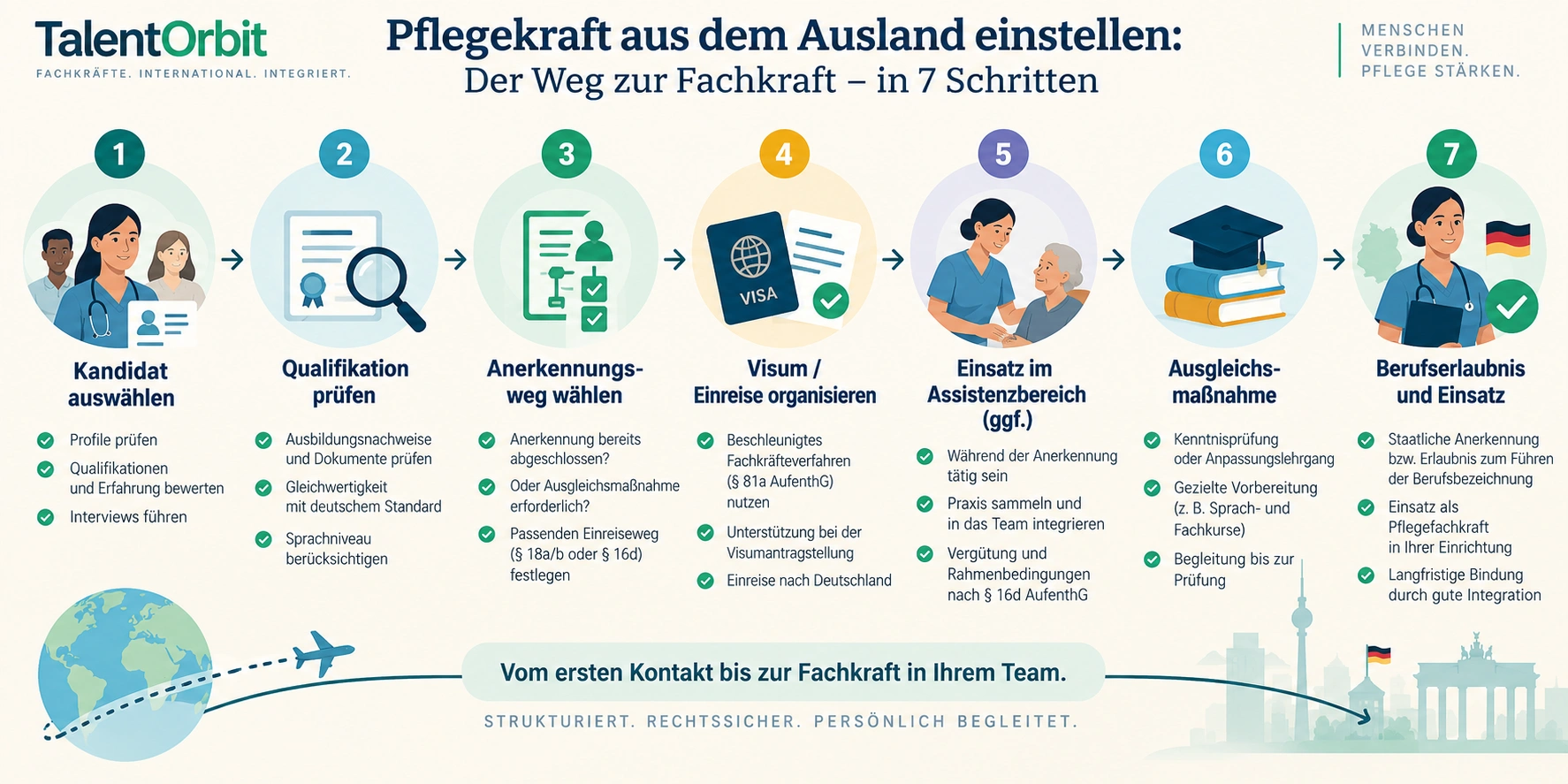
This page is aimed at clinics, nursing homes, outpatient services and medical care centers that want to recruit international nursing professionals or doctors. The perspective of employers is described: What must be clarified before the selection process? When can the person enter the country? When can they work in the assisting sector? When does they count as a nursing professional? And what tasks remain in your facility?
It was written by TalentOrbit International GmbH. We connect international professionals and help employers with selection, recognition, entry, and integration, to the extent agreed upon. If you are primarily looking for a matchmaker, you can find the description of the services on our page about matching services. Recruitment of nursing staff from abroad.
A question that isn’t answered here? Call us: +49 2173 2653870.
An international caregiver may only be employed as a care worker if the professional requirements are met and the permit to hold the protected professional title has been granted. Therefore, recognition is not just a document-related process on the sidelines; it is the factor that determines your personnel and service planning.
A state authority is responsible, and who that is depends on the federal state. In Bavaria, the responsibility has been with the State Office for Nursing since July 2023, in Hesse with the State Office for Health and Care, and in North Rhine-Westphalia with the respective regional government. Once granted, the recognition is valid nationwide.
These two points are regularly mixed together, and the confusion costs planning time.
Both do not necessarily go together. A nursing professional with Indian citizenship and a degree obtained in Poland needs a residence permit; however, their degree is reviewed according to European rules. A Romanian citizen with a degree from the Philippines does not need a residence permit, but their degree is reviewed individually. Therefore, always ask about both, and do so separately.
| Where the qualification was acquired | How it is tested | What that means for the schedule |
|---|---|---|
| EU, EEA and Switzerland | If the training meets the minimum requirements of Directive 2005/36/EC and the required documentation is provided, it will be recognized without further substantive examination. If automatic recognition does not apply, for example in the case of older or differently structured training courses, a separate examination will be required. | Most often the shortest route. The remaining requirements are proof of language proficiency and the issuance of a permit. If assessed individually, an adaptation course or an aptitude test may be considered as a compensatory measure. |
| Third countries | The standard procedure is the individual examination of equivalence based on the submitted documents. According to § 40, paragraph 3a of the PflBG, the professional can also forgo this examination and choose directly a knowledge examination or an adaptation course. | The longer journey. The renunciation can shorten it because fewer documents and translations are needed. However, it is final and cannot be withdrawn. |
More about the comparison of the education systems: Nursing education in international comparison · Nursing professionals from Croatia
Four prerequisites must be met before permission is granted.
If the authority determines that the training does not meet all German requirements, the notice describes the differences found. For your institution, this time is important because it indicates the need for qualification, leave, and deployment planning. The choice between the options is up to the professional, not the authority or you.
In third-country transfers, Section 40(3a) of the PflBG additionally opens the option of waiving the individual equivalence check. This saves time and documents, and reduces processing time. The waiver is final; therefore, this decision should be made at the beginning of the procedure and not in the middle of it.
In depth: nursing knowledge examination · Deficit decision for caregivers · Recognition of foreign qualifications
The residence permit regulates entry and employment. The professional recognition regulates whether the person may carry out the protected professional title and work as a nursing professional. Two levels, two procedures, two time schedules.
All three of the following procedures apply to nationals of third countries. Those who hold the nationality of an EU or EEA country or Switzerland do not need a residence permit to work in Germany. Professional recognition remains required in both cases.
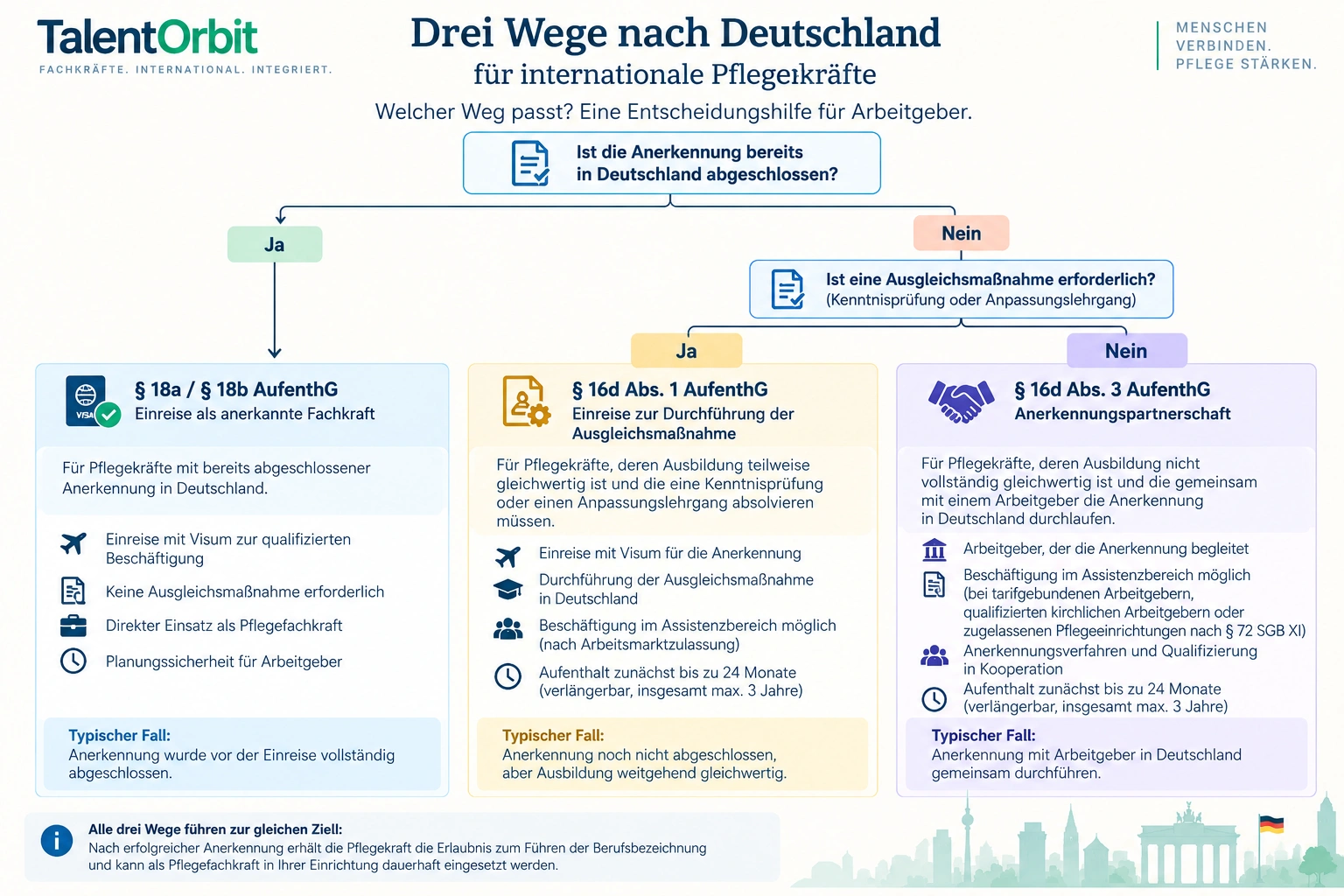
| Gone | When it fits | Most important prerequisites | Deployment in your facility |
|---|---|---|---|
| Recognition before entry Sections 18a, 18b AufenthG |
If equivalence has been established and the permission to hold the professional title is available or has been granted | Recognized qualification, proof of language proficiency, and concrete job offer. For the residence permit, it is sufficient under § 18, paragraph 2, no. 3 of the AufenthG that the professional practice permit has been granted. or agreed to is | As a nursing professional only after the permit has actually been issued. A confirmation is sufficient for entry, not for practicing the profession |
| Recognition in Germany Section 16d, paragraph 1 of the AufenthG |
If an adaptation course or a test is still pending | Entry for the qualification measure. German language skills equivalent to the measure are generally required; the minimum level is usually A2. The residence permit is issued for up to 24 months and can be extended for a total of up to three years. | Not as a nursing assistant, as long as the permission is not available. Employment independent of the measure is subject to a limit of 20 hours per week. Employment whose requirements relate to the professional knowledge required later is possible without this hourly limit under § 16d, paragraph 2 of the AufenthG, provided the Federal Employment Agency agrees. |
| Recognition Partnerships (Anerkennungspartnerschaft) Section 16d, paragraph 3 of the AufenthG |
If the professional is to work with you from the beginning during the process | A vocational qualification recognized by the state in the country of training with a duration of training of at least two years or one that is officially recognized there Higher education degree. In addition, German language skills corresponding to the intended activity are required; at least level A2; a concrete job offer; the suitability of your institution for training or further qualification; a written agreement on the obligations of both parties; and the approval of the Federal Employment Agency. | Employment from the start; the recognition is carried out in parallel. In nursing care in the assisting area, until permission is granted. The additional requirements for this apply in the next section. |
In nursing, the professional works in the assistant sector until they are allowed to do so, that is, below the intended target profession. This is precisely the prerequisite that is regularly overlooked in practice. § 16d, paragraph 3 of the AufenthG generally requires qualified Employment. The law only provides for this requirement in two cases, when professional practice authorization would be required for the activity.
For the practice, two things are important in this regard. First, the recognition partnership for licensed care facilities is significantly more accessible than the commonly held short version that suggests „only for salaried employers.“ Second, the remuneration in both cases is based on the intended profession and not on the assisting work that the person actually performs during this phase. This should be included in the personnel cost accounting from the very beginning.
The remaining requirements remain to be met in both cases, in particular the suitability of the business to accompany the qualification and the written agreement with the professional. Before concluding the contract and determining the specific implementation details, you should clarify how the foreign affairs office and the Federal Employment Agency will assess the individual case.
Anyone who has completed a nursing training program below the three-year professional training qualification can be employed as a nursing assistant under § 22a of the BeschV in conjunction with § 19c of the AufenthG. A state-recognized nursing assistant training program, recognized under federal or state law, or the determination by the competent state authority that a qualification acquired abroad is equivalent to it are required.
This is not a separate residence permit, but an employment opportunity within an existing one. This route is particularly interesting when the need is not exclusively at the professional level. It does not suit everyone who wants to become a nursing assistant.
When granting a residence permit for the first time pursuant to § 18a or § 18b of the AufenthG, an additional requirement applies from the completion of the 45th year of life: an income of at least 55 percent of the annual contribution threshold in the general pension insurance, i.e. 4,647.50 euros per month or 55,770 euros per year in 2026, or proof of adequate retirement provision. In the case of care work, salary rates do not always exceed this threshold, which is why this point should be examined early on.
For entry for a recognition measure under § 16d of the AufenthG, this threshold is not relevant. Therefore, always check the age limit on the actual residence permit that is intended to be issued.
In depth: Our recruitment process · Process check for employers
No one can call a fixed total duration a serious statement unless they know the individual case. The order of the milestones, on the other hand, is fixed, and a project plan can be based on it. The following overview shows which evidence must be available when and by whom it is obtained.
| Milestone | What must be present | Who is responsible |
|---|---|---|
| Before the recognition application | Certificates of completion, training records and professional experience, translated and certified. Decision on whether to waive the equivalence examination pursuant to § 40, paragraph 3a PflBG | Professional person, supported by the mediation |
| Before applying for a visa | Employment contract that fits the chosen route of residence. In the case of a partnership of recognition, additionally include the written agreement regarding the procedure. In the case of using the accelerated procedure, include the agreement with the foreign affairs authority. | Employer |
| Before entering the country | Residence permit or visa. The language level required for the purpose of residence, in general at least A2 according to § 16d. Apartment and first day of work arranged | Foreign representation, foreign affairs office, employer |
| Before starting work in the assistant department | Approval from the Federal Employment Agency, as necessary. Classification and remuneration according to the requirements of the target profession. Designated practical instruction and contact person | Federal Employment Agency, Employers |
| Before the compensatory measure | Deficit notice. Place in the adjustment course or exam date. Leave from the work schedule. Approved funding, if requested | State authority, educational institutions, employers |
| Before being employed as a nursing professional | Granted permission to hold the professional title. Proof of language proficiency at the level required by the state authority, usually B2. Medical certificate and reference letter | State authority |
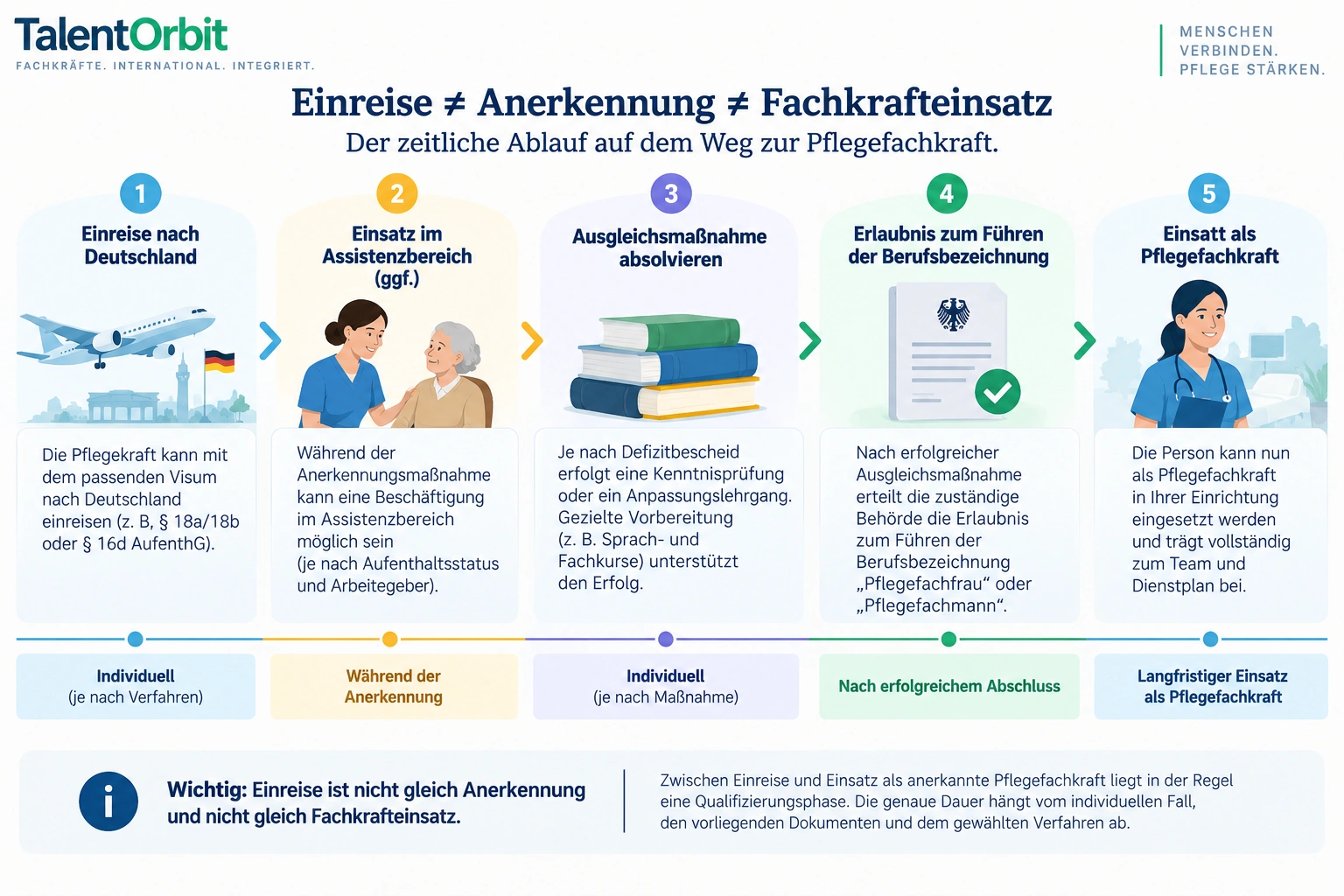
For nursing professionals and doctors, you can use the accelerated professional qualification procedure. Employers can apply to the Foreigners’ Office and conclude an agreement there. The fee is 411 euros under § 47, section 1, no. 15 of the AufenthV, and applies even in the event of rejection. Under § 81a, section 4, AufenthG, the procedure can include the family reunification of spouses and minor children if the visa applications are submitted in close temporal connection.
However, deadlines do not only exist in the accelerated procedure. In the regular recognition procedure as well, the competent authority must decide within a legal deadline, calculated from the completeness of the documents: usually three months, in certain case groups four. The Regional Council of Stuttgart explicitly states four months for the care. The accelerated procedure shortens this deadline to a standard period of two months, the Federal Employment Agency grants one week for approval and the foreign representation three weeks for scheduling the appointment.
Two points are crucial here. First, the deadline concerns the Decision about the application. An adaptation course or an exam are part of the recognition process, but the time required for this does not fall within the decision-making period. Two months until a decision therefore does not mean two months until recognition is complete. Secondly, the two months only begin once the documents are complete, which is why carefully prepared applications are the real time-saver.
For further information, Accelerated skilled worker procedure under § 81a AufenthG
Conversations with nursing directorates are being held here, so this point is mentioned here and not in the small print.
As long as the permission to use the professional title has not been granted, the person may not use the professional title and may not be employed as a nursing professional. For your planning purposes, this usually means that during this time they are not considered a professional, for example in terms of the professional ratio. How this is handled in your state and for your specific setting should be clarified in advance with the relevant authority, as the regulations differ.
What you should expect to happen during this phase:
An organization that plans for this phase will be successful. One that calculates with a specialist who can start immediately will be disappointed. A practice that applies this approach to several clinics is helpful: having its own job title for this phase, such as „Nursing Assistant in Recognition,“ so that the team is clear that it is neither an intern nor an assistant.
In depth: Typical concerns of clinics · Integration of foreign nursing staff
To be recognized as a nursing professional, the countries usually require German at level B2. Two details about this are more important for planning than the number itself.
First of all, the proof does not have to be submitted in every federal state at the time of application. In Hesse, for example, it is sufficient to submit it by the time the permit is issued. This allows you to have the application and language course running in parallel instead of one after the other. We will check with the relevant authority whether this also applies to your federal state before the schedule is set.
Secondly, B2 on paper is not the same as B2 in the night shift. A certificate says little about transfers, phone calls with family members, dialects, or documentation. The German Hospital Institute surveyed nursing staff at 243 general hospitals in 2024 for the German Hospital Society. The result: B1 is widely considered insufficient in the hospitals, and two of the six most intensively surveyed maximum providers employ their own language instructors. Therefore, professional language training should be part of the onboarding process, not its end.
For entry under § 16d of the AufenthG, lower levels of knowledge may suffice. In the case of a partnership for recognition of residence, at least A2 is required from a legal standpoint, and the knowledge must be appropriate for the intended employment. A2 is thus the legal minimum for residence, not the level at which a course or exam can be completed.
The emergency department, intensive care unit and operating room have different requirements. Before the interview, check what activities the person actually performed, which experience fits your department and what training is required. A foreign degree or professional certification does not automatically indicate every specialization that the specific job requires.
The care service management and the relevant department should jointly define the requirements: tasks, shift model, documentation, professional language communication and available guidance. Handovers and emergency communication are explicitly included in the onboarding process.
In long-term care, in addition to professional qualifications, communication with residents and their families, dealing with dementia, and reliable relationships are important. For outpatient services, tour organization, mobility, and preparation for independent tasks are also essential.
Discuss the working reality early on: living space, accessibility of the facility, shift schedules, contact persons and support outside of work hours. Especially in rural locations, practical everyday usability determines whether an employment relationship is worthwhile. One advantage of long-term care: Registered care facilities under § 72 of the Social Security Act XI have easier access to recognition partnerships, as described above.
A short-term wave of illness requires a different solution than permanently unfilled positions. Domestic recruitment, temporary employment, and international recruitment can complement each other. What is crucial are the actual staffing needs and the moment when a fully deployable specialist is needed.
| Gone | Suitable for | What to plan for |
|---|---|---|
| Domestic recruitment | Permanent jobs from the already available labor market | Suitable applications, attractive working conditions and swift decisions. Availability and duration of positions remain open. |
| Temporary work | Acute outages and temporary bridging | Availability, billing rates, onboarding, and changing deployment forces. |
| International direct marketing | Planned establishment of their own team through direct employment | Unique recruitment and onboarding costs, language and recognition preparation, and internal integration capacity. |
A practical transition: The establishment is initially filling acute gaps with available forces and is simultaneously beginning international recruitment. Only when the actual deployment status is clarified will the bridging effort be reduced. International recruitment does not provide staffing for the next shift.
If you are calculating, then for the same period and the same usable Qualification: on the one hand the actual temporary work costs, on the other employer personnel costs, recruitment, qualification, support and, if necessary, ongoing bridging. An assistant during recognition does not replace a fully qualified nursing professional. Therefore, a flat-rate amortization in the first year cannot be promised, and anyone who promises it has not taken the recognition phase into account.
The residency path does not answer the question of how to find suitable candidates. There are essentially three models for this.
| Recruitment route | Advantage | What employers should consider |
|---|---|---|
| State programs, such as the Triple Win | Standardized processes, defined recruitment framework, including language courses in the country of origin. | Available countries of origin, program prerequisites, current fee model, and influence possibilities in selection and time planning. |
| Private personnel agency | The scope of services and the candidate profile can be individually agreed upon, from individual steps to the entire process. | Transparency of services, fair recruitment, clear responsibilities and contractual arrangements in the event of termination or change. See checklist below. |
| Direct recruitment | Full control over addressing and selection. | Own resources for document verification, recognition, residence rights, government communication, translations, and integration. |
Compare what is being paid for the brokerage fee, and not just its amount. These ten questions are more reliable than the price in determining the offers.
We describe our own approach in Why TalentOrbit. At us, candidates do not pay any brokerage fees. We will provide a written list of the services provided in detail before the start of the process.
The West Balkan regulation under § 26, paragraph 2 of the BeschV is an easier access to the labor market for nationals of certain West Balkan states, with a quota of up to 50,000 approvals per year. It is not a recruitment program and nor is there a recognition scheme. As a nursing professional, no one may work in this way without permission to hold the professional title. Therefore, the regulation is useful as a temporary residence permit during the recognition process or for employment in the assisting sector.
Which country of origin is the best cannot be answered in a general way. What matters are the training structure, work experience, language learning path, availability of qualified candidates, and the recognition practices for qualifications from that country. However, a legal question must first be addressed, which hardly ever appears in offers for comparison.
According to § 38 of the BeschV, the recruitment in certain states and the placement of workers from these states for employment in health and care professions is permitted. only by the Federal Employment Agency Which countries are included in this is specified in the annex to the Employment Ordinance. It currently covers 55 countries and implements the WHO Health Workforce Support and Safeguards List of 2023.
Four points are important for employers in this regard.
Check this point before writing a country into the tender and have it confirmed by a intermediary that the property has been inspected. The list is changing, and an outdated English version from 2020 is still available on the Federal Agency's website.
For many workers from these countries, the process is simpler because the European recognition rules apply. Within the EU, most caregivers come from Poland, Croatia, and Romania. Professional recognition remains required here as well, and for nationals of these countries, only the residence permit is required.
In the case of third-country nationals, individual recognition and entry planning are the main focus. We work with partners in the Philippines, India, Kazakhstan, Kyrgyzstan, and Georgia. In the Philippines, a four-year university degree is the standard completion of studies, in India the training system is broad, and in Kazakhstan and Kyrgyzstan university education follows a post-Soviet system. None of these countries are listed on the list of § 38 BeschV.
Which country is suitable for your position is determined by the specific candidate profile and the recognition pathway, not by the country's offer.
A total amount that is reliable cannot be stated without a specific case, because it depends on the country of origin, the recognition pathway, the level of language proficiency, the federal state, the mediation model, and the self-financing component. What can certainly be stated is the administrative fees, because they are set out in fee regulations. And the result surprises most institutions: the fees are the smallest part of the bill.
| Budget position | Height and what it depends on |
|---|---|
| Equivalence test | State fee. North Rhine-Westphalia: 150 euros. Hesse: 110 euros |
| Permission to use the professional title | North Rhine-Westphalia: 60 euros, with an additional language test 80 euros. Hesse: 110 euros |
| Organization of the knowledge test | North Rhine-Westphalia: 20 euros per exam section. This is the fee charged by the authority, not the price of the exam itself. |
| Examination costs of the examination school | Not regulated in fee regulations. The Hamburg social authority lists in its brochure approximately 300 euros for the oral part and approximately 500 euros for the practical part; these amounts are as of December 2023. |
| Decision following successful settlement measure | North Rhine-Westphalia: €37.50 to €87.50 |
| Accelerated skilled worker procedure | 411 euros, legally set, also applies if the request is rejected |
| National visa | 75 euros. Usually paid by the professional |
| Residence permit | 100 euros upon renewal, 93 to 96 euros upon renewal |
| Certificates and translations | Variable, depending on the scope and origin of the documents. The waiver under § 40, paragraph 3a PflBG reduces this position |
| Adaptation course | Variable, according to the decision and educational institution. Eligible, see below |
| German and professional language courses | Variable, according to initial level and format. Partially covered by federal professional language courses |
| Flight and initial equipment | Variable, according to country of origin and agreement |
| Apartment and onboarding | Variable, according to the housing market and support model |
| Internal personnel costs | Practical guidance, HR coordination, leave of absence, mentoring. In almost every calculation, it is underestimated. |
| Placement fee | By profession, number of positions and scope of work. You will receive a written offer before the start of the project. |
The following calculation is one Model calculation for illustration, No offer and no forecast for your case. It only shows the positions that are listed in the fee regulations.
Assumptions: a nursing professional from the Philippines, third-country qualification, employment in North Rhine-Westphalia, language level B1 at the time of selection, equivalence assessment with a deficiency notice, compensation through the knowledge assessment, accelerated professional recruitment procedure used.
| Position | Legal basis | Amount |
|---|---|---|
| Equivalence check for establishment | AVwGebO NRW, tariff item 12.1.3.2.1 | 150.00 Euro |
| Organization of the knowledge test, two parts | AVwGebO NRW, tariff item 12.1.3.2.4 | 40.00 Euro |
| Decision following successful settlement measure | AVwGebO NRW, tariff item 12.1.3.2.5 | 37.50 to 87.50 euros |
| Permission to hold the professional title with a language test | AVwGebO NRW, tariff item 12.1.3.1.2 | 80.00 Euro |
| Accelerated skilled worker procedure | Section 47, paragraph 1, no. 15 of the AufenthV | 411.00 Euro |
| National visa | Section 46 of the AufenthV | 75.00 Euro |
| Residence permit, issuance | § 45 AufenthV | 100.00 Euro |
| Total of administrative fees | 893.50 to 943.50 euros |
What is not included in this amount And in practice it exceeds by a factor of several: translations and certifications, the exam school’s examination costs, language courses up to B2 and beyond, flights and initial equipment, housing support, the placement fee, and one’s own working time for practical instruction, leave, and coordination. Anyone who wants to estimate the total costs must quantify these positions exactly, and the most expensive of them are not included in any fee schedule. For your location and your case, we will calculate them in the initial conversation with you.
Fees are changing. The current status as of October 2026 is based on the above legal bases. Other federal states have different amounts, and some states do not publish their fees.
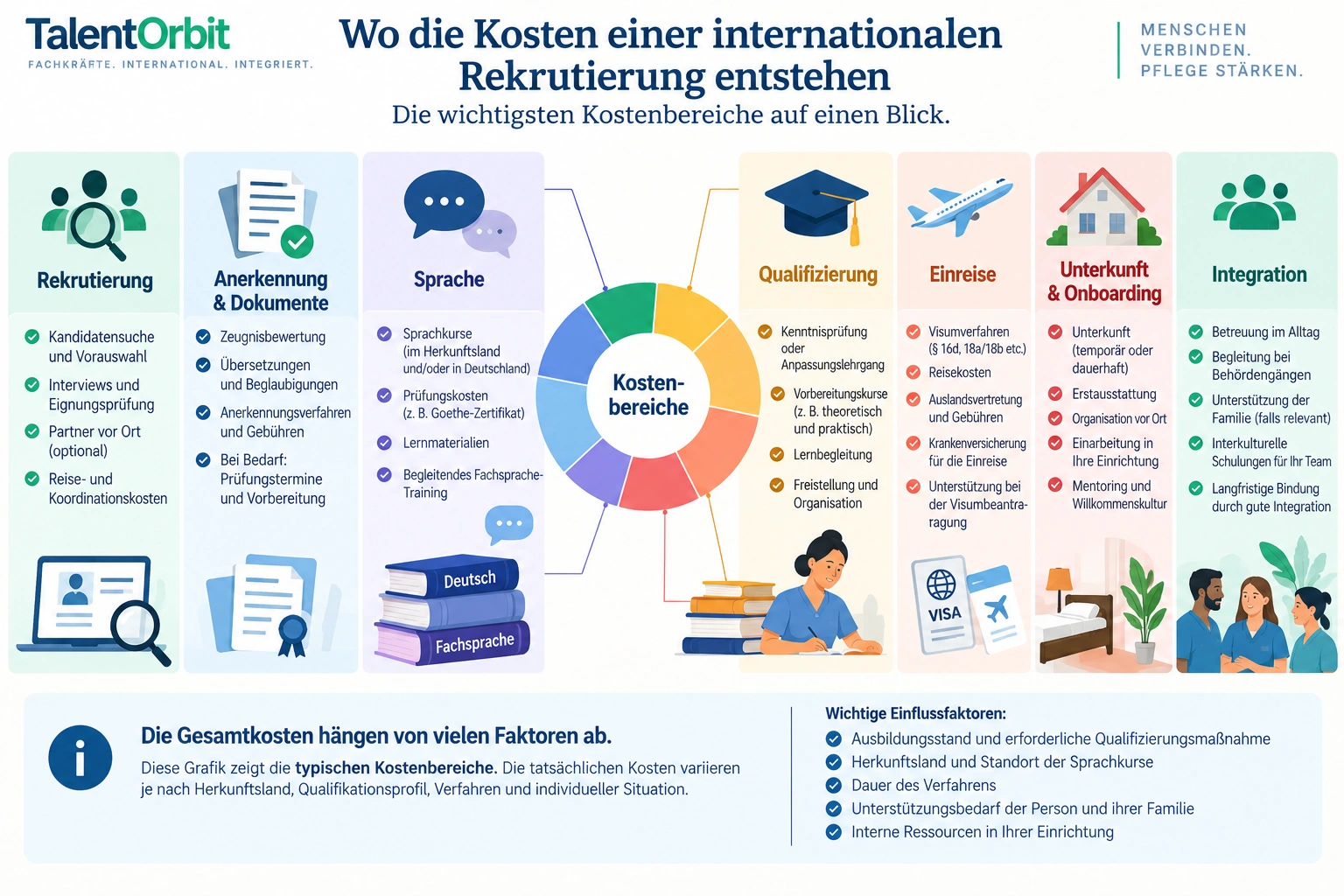
Funding programs are often mentioned in bidding discussions but rarely properly attributed. The question of who is the applicant is crucial: the employer or the professional.
In addition, the federal states are developing their own programs. These often change, which is why the exam should be project-specific and not based on a list.
Not sure which position you are applying for? Discuss your situation over the phone: +49 2173 2653870.
Recruitment brings someone into the company. Whether the person stays depends on that, and most terminations happen in the first few months.
There is research to support this, and it contradicts the widespread expectation. A 2019 study by the Hans-Böckler Foundation, which included nearly 60 interviews with migrant and German caregivers, supervisors, and employers, concludes that everyday work is mostly successful and that permanent integration into the workplace remains the real challenge. Conflicts between new and established employees arise primarily from differences in training content and the division of tasks between doctors, nurses, and support staff. If these are interpreted as „cultural differences,“ they become more acute. Migrants report being excluded from information flows and treated as learners rather than as professionals who have completed their training. If such conflicts remain unresolved, many change departments or hospitals, leave nursing care, or return.
In practical terms, this means that time for professional exchange, designated responsibilities, and sufficient staffing are not soft issues; they are the prerequisite for integration efforts to be carried out at all.
The following two institutions have published their own integration plans. They are No customers of TalentOrbit and are mentioned here as documented examples because they show which building components are actually used.
University Medical Center Münster. The house has been recruiting internationally since 2014 and published its integration management concept in 2023. Components: a dedicated integration team within the nursing development and nursing school, video contact with candidates in the country of origin, a language course up to B1 before arrival at the hospital, pick-up at the airport, a welcome café where the new colleagues meet their mentors on the ward before starting work, one prepared mentor for each nursing staff, a dedicated integration station with mixed-nationality teams, furnished housing units close to the campus with a rent subsidy, bicycles and bike courses, and intercultural training for the ward teams. In the event of a deficit decision, the knowledge test follows after twelve to fourteen weeks of block instruction with included on-site phases. During this time, the person holds the position title „Nursing Specialist in Recognition“. The concept itself cites language difficulties, problems in the recognition process, homesickness and family reasons, as well as conflicts on the ward as reasons for terminations. UKM’s integration management concept
Evangelical Clinic Bethel in Bielefeld. The integration plan includes two dedicated positions for integration officers, a bilingual employment contract, a language mentoring program with virtual exchanges even before entry, a furnished room in the clinic’s own residential facility for one year regardless of the recognition status, voluntary tandem partners in the same team, in the same shift and at the same hierarchical level for at least six months, and short team briefings at the start of each new group. The adaptation course is conducted by the clinic’s own nursing school. Integration concept of the EvKB
Both houses do not publish any statistics on the number of residents, and there are no reliable figures available for Germany. Anyone who claims to have them should provide the source.
The German Hospital Institute surveyed the German Hospital Association in 2024 regarding the prevalence of such components. According to the results, 56 percent of the surveyed general hospitals have an integration officer or an integration coordinator, 96 percent employ internationally recruited staff, and mentoring programs typically last three to six months. The most common problems cited by the hospitals are the long duration of recognition, the lack of external integration support, and the effort involved in applying and selecting candidates.
In detail: Integration of foreign nursing staff: practical guide for employers
Anyone who recruits internationally for the first time should align the number of employees with the available support staff, not the needs. A small initial group allows for testing the document review, recognition, and onboarding processes before launching multiple stations or locations simultaneously.
Internal delays are the part you have full control over. Book fixed interview times and agree on a realistic deadline for responses, say two working days. This is an internal work goal and not an assurance of government deadlines. Separate out how long your own selection takes, which documents are missing, and which steps depend on authorities or educational institutions. This way, you can ultimately say where the time really went.
Sample profile for illustration purposes. It does not describe a specific applicant and is not an offer.
| Conclusion | Bachelor of Science in Nursing, four-year degree program, Philippines, state-accredited, graduation 2019 |
|---|---|
| Professional experience | Four years, of which three were spent in an internal medicine emergency department of a hospital with 300 beds; one year in the emergency room |
| Language level | German B1, certificate from July 2026. Course up to B2 is running, exam date is scheduled |
| Documents | Diploma, transcript of records, professional registration and work certificates are available, certified and translated. Application for a leadership certificate |
| Recognition status | Application submitted to the competent regional government; receipt confirmed. Deficiency notice expected; compensation to be determined through a knowledge test |
| Planned route | § 16d, paragraph 1 of the AufenthG, employment in the assistance sector until permission is granted |
| Open points for you | Practical guidance for exam preparation, exemption from the language course, apartment from the month of entry |
A profile in this form is the minimum requirement for a decision. If the recognition status is missing, the most important information is also missing.
Clinics that recruit nursing and medical staff can jointly organize needs assessment and project coordination. However, the professional regulatory procedures must be planned separately, as nursing recognition and medical licensing are different processes with different documentation requirements.
The license to practice medicine without restriction is the permanent permission to practice medicine. The professional license under § 10 of the Federal Medical Ordinance is, however, not an automatic intermediate step but a permission at the discretion of the authority. It is limited in time, revocable, and can be restricted to certain activities or a specific place of employment. For clinics, it is often the way in which a female doctor can even start working. You should plan to use it only when it actually exists. A pending application is not sufficient.
Basics: § 10 of the Federal Medical Association Code and Federal Medical Association, medical practice in Germany.
As a rule, a two-stage proof of knowledge is required: general German language skills, usually at B2 level, are a prerequisite for admission to the Fachsprachenprüfung exam, and in this exam, professional-level language skills are assessed; the countries regularly base the level on C1.
However, the federal state decides on all three points. Which certificates are valid as proof, who takes the specialist language exam and in which cases it is waived, are regulated differently in the various states. In many countries the exam is administered by the state medical board, in others by another institution. Exemptions are possible, for example, in the case of medical studies completed in German. The relevant approval authority’s information is always decisive, and not a general rule. If the degree is obtained in a third country and the equivalence is not established, a knowledge test follows.
In the joint project, each professional group therefore receives its own schedule of activities. This prevents the qualifications, recognition, and employability of doctors and nursing staff from being equated.
Only when the recognition is completed and the permission to hold the professional title is granted. If the procedure is still ongoing, depending on the type of residence permit, employment in the assisting sector is possible, and the professional title must not be held by the person. This point is most often underestimated in planning.
For recognition in nursing, the Länder usually require B2. From a residence perspective, § 16d of the AufenthG often requires A2, while for a recognition partnership at least A2 and appropriate to the intended activity. A2 is the minimum level of residence permit, not the level for a course or examination. In the case of doctors, B2 is generally the general minimum requirement plus professional language skills at C1-Niveau in the professional language exam, with differences depending on the federal state.
No. For terminations from the EU, the EEA and Switzerland that meet the minimum requirements of Directive 2005/36/EC and are duly proven, the substantive individual examination is not required. For terminations from third countries, the individual examination is the standard procedure. The professional can choose to waive the individual examination according to § 40 Abs. 3a PflBG and choose directly a knowledge examination or an adaptation course. This waiver is final.
Yes, for a care facility approved under § 72 of the Social Security Act XI. § 16d, paragraph 3 of the AufenthG excludes the requirement of qualified employment in this case without requiring binding collective bargaining. However, classification and remuneration must correspond to employment that meets the requirements of the intended occupation. The remaining requirements of the partnership remain to be met.
Yes, to a varying extent. For an employment that has nothing to do with the measure, the limit of 20 hours per week applies under § 16d, paragraph 1 of the AufenthG. For an employment whose requirements relate to the professional knowledge of the intended profession, § 16d, paragraph 2 of the AufenthG does not provide for such a hourly limit, provided that the Federal Employment Agency agrees.
No. According to § 38 of the BeschV, recruitment and placement for health and care professions from the countries listed in the annex to the Employment Ordinance may only be carried out by the Federal Employment Agency. The annex currently covers 55 countries. Self-application to a generally accessible job advertisement is not included in this, but the employer must be able to prove this. Please check the annex before a country enters the tender.
Training subsidies from the Federal Employment Agency flow directly to the employer under §§ 81 and 82 of the Social Security Act III; these include course costs and a subsidy to the employee’s salary. Counseling and education vouchers must be available before the start of the measure. The federal recognition subsidy, however, can only be applied for by the professional themselves, not the employer, and language courses are excluded from this.
More common in nursing than in other industries because recognition there is the longest part of the process. It shortens the recognition authority’s decision-making period to a standard two-month timeframe and schedules approval and visa appointment. A completed recognition within two months is therefore not guaranteed, as an adaptation course or examination is part of the procedure but does not fall under the decision-making period. The fee is 411 euros and is also charged in the event of rejection.
The official fees in the model calculation are approximately 900 euros. Everything else depends on the case: translations, examination costs, language courses, flight, accommodation, mediation, and your own working time. A binding quote indicates which services are included and which costs are additional for you.
The scope and duration of the accompaniment, as well as arrangements for an interruption or a subsequent appointment, should be determined in writing before the contract is signed. Automatic replacement accompaniment must not be assumed without appropriate agreement. Early discussions about workload, housing, language, and expectations help to identify reasons as long as something can be changed.
No. A mediator can review documents and coordinate procedures. The competent authorities decide on recognition, professional registration, and visas. A roadmap creates transparency but does not replace an official decision.
Tell us which care or medical positions you would like to fill, in which location and for what period. In the initial consultation, we will discuss your qualification requirements, existing candidates, the recognition pathway, and internal resources. This will determine whether a single procedure, a small pilot, or a phased rollout is suitable for your facility. The consultation is free of charge and there is no obligation to proceed.
Discuss personnel needs · Telephone +49 2173 2653870 · info@talentorbit.de
Further information: Employer area · Personnel recruitment nursing · Why TalentOrbit · Talent pool · Regulated and non-regulated professions
Right of residence and employment
Professional Law Nursing and Medicine
Funding
Data, procedures and practice
Status: October 2026. This article provides employers with a general overview and does not replace legal or regulatory advice in individual cases. Recognition requirements, responsibilities, fees, and administrative practices vary from state to state and are subject to change. The applicable regulations and information provided by the relevant authorities are authoritative.