

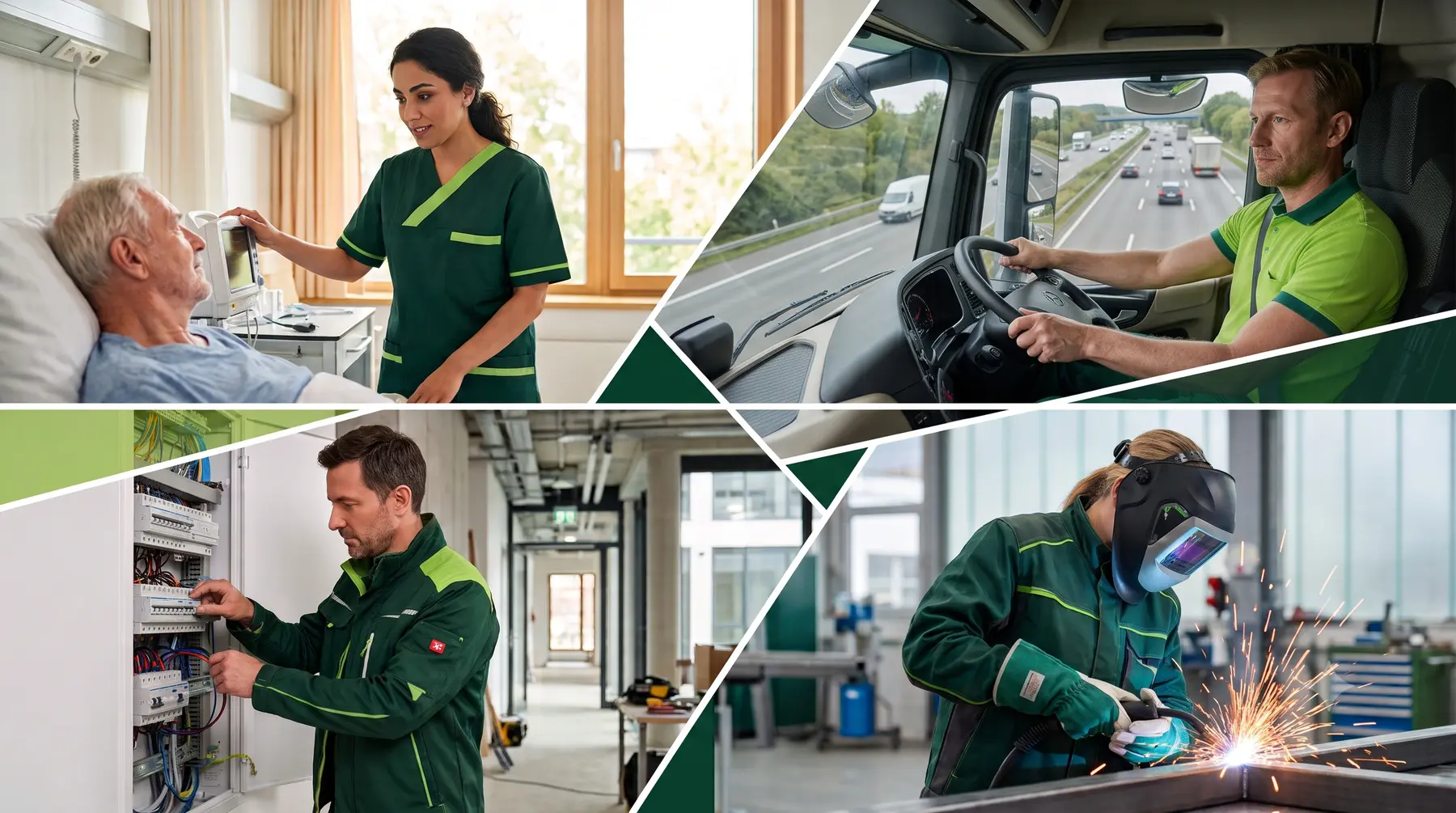
They have been looking for an electrician for eight months. The job is advertised, the salary is right, but no one applies. Then someone suggests looking abroad – and you remember what you heard about foreign nursing staff Have read: admission procedure, language test at B2 level, one and a half years of waiting time. So, just leave it.
That would be a shame, because all of that does not apply to your profession.
Between a Nursing specialist And for an electrician, there is a legal difference that almost determines everything: duration, request for service, administrative procedures, costs. This article explains what this difference is, which professions are actually lacking in Germany and what the law requires in each case.
Note: This article serves general information purposes and does not replace individual legal advice. Residence and professional rights change; the most relevant version is the one in effect at any given time. For your specific case, please contact a specialist lawyer or the relevant authority.
Germany divides professions into two groups: regulated and non-regulated.
What does „regulated“ mean? A profession is regulated when the law links its practice to a government license. Anyone who does not have this license may not practice the profession – regardless of how well trained they are or how urgently someone wants to hire them. For foreign qualifications, the path to this license leads through an Recognition procedure. Only when the authority has assessed the foreign education as equivalent can work be undertaken.
Unregulated professions do not face this obstacle. They may be practiced without anyone issuing a certificate. This includes almost all vocational training apprenticeships in the trades and industry at company level.
This classification determines almost everything else. Let’s look at both cases in more detail.
Anyone who wants to use the professional title „Nursing Specialist“ or „Nursing Specialist“ in Germany needs a permit for this. Nursing Professions Act (PflBG) Section 2 lists the requirements. In addition to completed training, health fitness and reliability, it states, under number 4, a requirement that many underestimate: the „knowledge of the German language necessary for the exercise of the profession“.
What this actually means is not specified in the federal law. It is up to the relevant state authorities to decide. In practice, they require a language certificate at the B2 level of the Common European Framework of Reference. Moreover, the Health Ministers’ Conference has decided that proof of a professional-specific language proficiency test should be provided instead of a general-language certificate.
For you as an institution, this means three things: First, without recognition, no one may work as a nursing professional, not even temporarily. Second: Proof of language proficiency is not a formality but a prerequisite for issuance. Third: Both must be provided before the first working day, which prolongs the entire process.
The requirements for care workers are lower. The PflBG recognizes in § 12 assistance and helper training courses regulated by state law as lasting at least one year, provided they meet the basic requirements decided by the Arbeits- und Sozialministerkonferenz and the Gesundheitsministerkonferenz. The responsibility lies with the states; therefore, the requirements differ depending on the federal state.
An electrician for energy and building technology, an HVAC mechanic, a car mechanic, a welder: These professions are not regulated at the company level. There is no professional license that someone would have to obtain, and therefore no recognition authority that would verify language proficiency.
This leads to a result that surprises many businesses: The law does not require a certain level of language proficiency for the employment of a foreign craftsman. No B2, no B1, nothing at all. Language requirements only arise through the chosen residence permit – and those are significantly lower, as the table below shows.
Does that mean language doesn’t matter? Of course not. Safety at work, customer contact and team coordination do not work without a common language, and for a professional who is to stay permanently, German is the foundation of everything. In practice, B1 has established itself as a sensible lower limit. The crucial point is this: This is your entrepreneurial decision, not a legal requirement. You can make it as it suits the situation.
Formal recognition of the foreign qualification is also voluntary. It may be worthwhile because it facilitates professional classification and provides benefits for certain types of residence permits. It is not a requirement for employment.
The Federal Employment Agency Every year, the BA examines around 1,200 occupational categories to determine whether there is a shortage. This is assessed using six indicators, including the vacancy rate, the occupational unemployment rate, and the wage development. For 2025, the BA identified 157 occupational categories with a shortage.
The Competence Center for Talent Retention (KOFA) At the Institute of German Business, at the same time, they calculate how many open positions are not calculable because there is no suitable unemployed person available with the required qualifications. The average annual vacancy in 2025 was 369,516 positions. Just over 61 percent of these were at the professional level, that is, people with completed vocational training – not academic graduates.
The largest gaps in the annual average in 2025:
| Profession | Not computably solvable | Share of all open positions |
|---|---|---|
| Electrical construction | 16.270 | 75,6 % |
| Elderly care | 15.233 | 78,1 % |
| Healthcare and nursing | 13.390 | 67,1 % |
| Automotive engineering | 13.327 | 60,6 % |
| Electrical operating technology | 13.011 | 78,2 % |
The movement in freight transport is notable. There were around 25,120 vacancies for professional drivers nationwide, and the gap grew by 20.6 percent compared to the previous year – while it decreased by 24.1 percent across all professions nationwide. The same applies to welding and joining technology, refrigeration technology, civil engineering, and the operation of earthmoving machinery.
An explanation that is rarely provided: The BA explicitly states that there is currently no general shortage of labor. In many professions, the supply exceeds demand significantly. The shortage is a problem specific to certain professions, not the labor market as a whole. Anyone who speaks in general terms of „a shortage of skilled workers“ is refuted by their own source.
| Nursing specialist | Craftsmanship, technology, logistics | |
|---|---|---|
| Regulated | Yes | No, at a social level |
| Recognition of the degree | Mandatory before starting work | Voluntary, no prerequisite |
| Proof of language proficiency is required by law | Yes, as a prerequisite for granting under § 2 No. 4 PflBG | No, only about the residence permit |
| Level of practice | B2, determined by the state authorities | B1 as an operational decision |
| Recruitment from abroad | For states of WHO list only through the BA, § 38 of the BeschV | No comparable restriction |
| Start of employment | After completion of recognition and proof of language proficiency | Depending on the procedure, already upon entry |
The recruitment line deserves an explanation because it is overlooked in practice. According to Section 38 of the Employment Ordinance (Beschäftigungsverordnung) Recruitment and placement in the countries listed in the annex to this regulation for health and care professions may only be carried out by the Federal Employment Agency. The basis is the Code of Conduct of the World Health Organization, which protects countries with particularly strained staffing levels. Violations are punishable by a fine. This provision does not apply to electrical, plumbing, automotive, construction, and logistics.
It is not the profession that determines the level of language skills; it is the path through which the professional arrives in Germany.
| Gone | Language level |
|---|---|
| Section 24a of the BeschV – Professional drivers | No legal requirement |
| Section 26, paragraph 2 of the BeschV – West Balkan regulation | No legal requirement |
| § 6 BeschV – Professionals with professional experience | The employer decides |
| § 20a AufenthG – Opportunity card | A1 |
| Section 16d, paragraph 3 of the AufenthG – Partnership of recognition | A2 |
| Regulated health professions | B2 according to the administrative practice of the Länder |
Therefore, anyone who brings B1 is above the requirements of the law in each of the five cases mentioned above.
Which path is the right one depends on the profession, the country of origin, and the degree. The five most important ones are:
The salary threshold under § 6 of the BeschV. This path is often advertised as the easiest because it does not require any recognition. However, it has one condition that rarely appears in advertisements: The salary must usually reach at least 45.3 percent of the annual contribution threshold in the general pension insurance. For 2026, that is 45,934.20 euros per year, or 3,827.85 euros gross per month.
What does this mean in concrete terms? According to the median wage, it is Unpaid unemployment benefits from the Federal Employment Agency In building electrical work, it costs around 3,765 euros per month, and in automotive engineering it costs around 3,588 euros per month. In both trades, therefore, a professionally paid worker with a median salary falls short of this threshold. If your business is subject to collective bargaining agreements and you pay according to collective agreements as a qualified professional, the threshold may be crossed. Otherwise, the path leads through § 18a AufenthG or through the recognition partnership, both of which do not have a salary threshold.
The age limit is 45 years. The Employment Ordinance attaches the initial approval of the Federal Employment Agency in the cases of §§ 6, 22a, 24a and 26 paragraph 2 to an additional condition: if employment is taken up after the completion of the 45th year of life, the salary must reach at least 55 percent of the annual contribution threshold, unless the professional can prove an adequate retirement pension.
This rule is not absolute, and this is often misrepresented. Aside from the prerequisites, there may be a public economic or labour market policy interest in employment, particularly at the regional level. The case in which the salary threshold is only slightly exceeded or the age limit is only slightly exceeded is also explicitly mentioned. In the cases of § 26 paragraph 2, this exception is narrower.
The first step is not recruitment, but assignment. Check whether your profession is regulated or not – this determines everything else. If it is not, second, consider which route of employment suits your position and calculate the salary threshold of § 6 of the BeschV against your actual starting salary. A wrong decision made early on costs a year.
If you want to know which path leads to a specific position, Call us. In the first conversation, we will clarify the assignment and tell you whether we have suitable candidates in our network.