In brief: For drivers from third countries, there are three options. According to § 24a, paragraph 1 of the BeschV, someone who already has both a driver's license and basic qualifications may travel. According to § 24a, paragraph 2 of the BeschV, someone who acquires both in Germany may travel – for this, up to 15 months are provided during which they are employed by you and are not yet allowed to drive. The West Balkan regulation under § 26, paragraph 2 of the BeschV only opens up the labor market and does not replace either a driver's license or qualifications. What matters to you: Since November 2023, the authorities no longer check whether a driver is allowed to drive. This examination is solely the responsibility of the employer, and it is punishable by fines and imprisonment.
For freight forwarders, transport companies, fleet managers and logistics service providers that are looking for drivers in the freight transport sector. For routes A and B under § 24a of the BeschV, a restriction applies: activities for which a Class B driver's license is sufficient are excluded from this. Therefore, positions in courier transport with vans cannot be filled through these two routes. The West Balkan regulation does not recognize this restriction.
The Federal Association of Freight Transport, Logistics and Waste Management estimated the gap in January 2026 at „120,000 plus X“ drivers, compared to „100,000 plus X“ a year earlier. Without the economic weakness, according to the association’s estimates, the gap would have exceeded 140,000 drivers.
More meaningful than the total number is the age structure. According to the BGL, around 30,000 to 35,000 truck drivers retire every year, while only about 15,000 to 20,000 follow suit. This results in a structural deficit of 15,000 to 20,000 drivers per year, regardless of the state of the order book. A recovery in the economy only sharpens this calculation; it does not alleviate it.
A note on how to handle such figures: Depending on the survey, values of around 70,000 to 80,000 are also circulating for the same period. Such figures differ because they count different things – reported open positions are different from the total demand estimated by associations. For personnel planning, it is less the amount of the number that is decisive than its direction, and that is the same in all surveys.
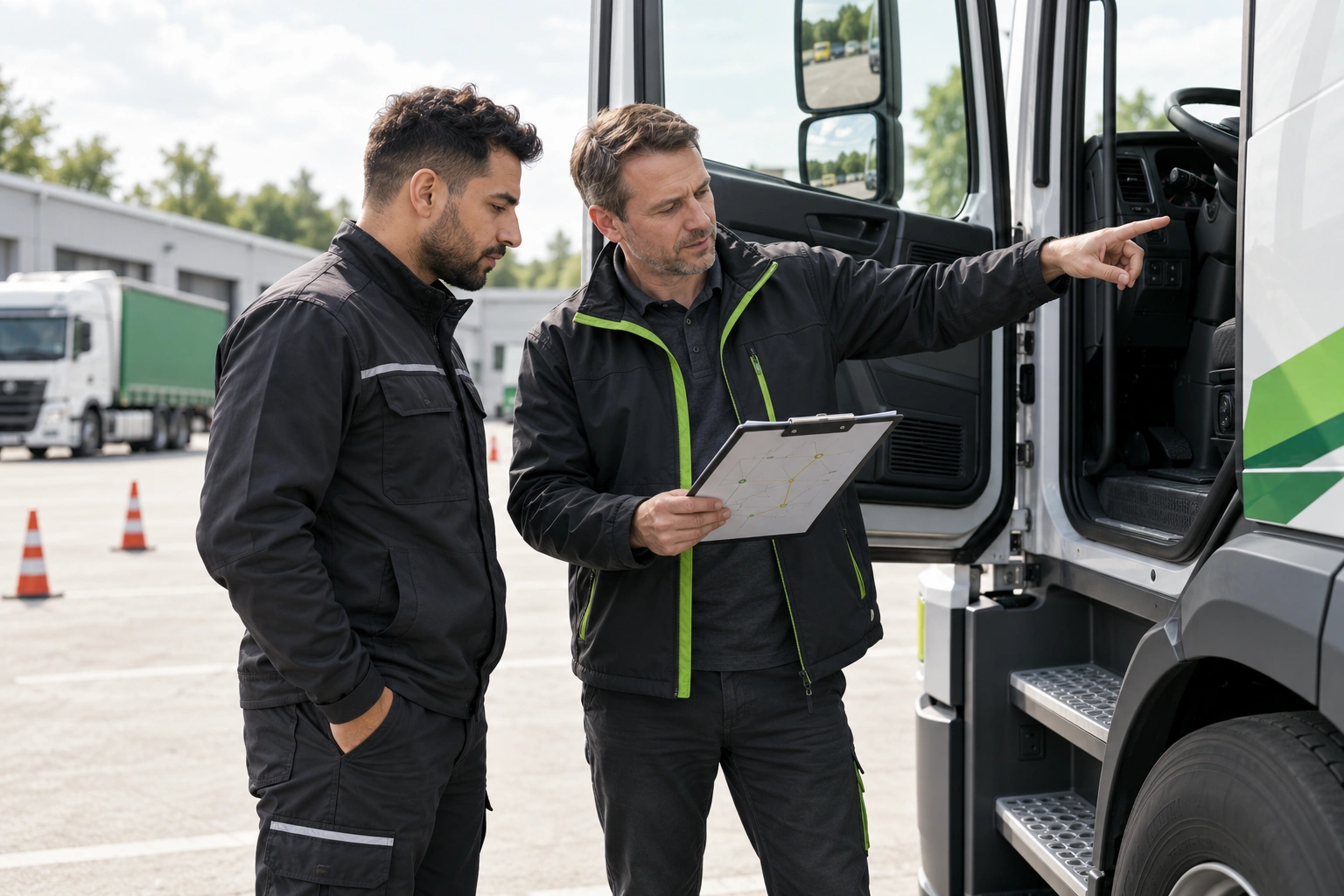
The crucial point almost always occurs before the first conversation: Does the driver already have the qualification, or does he or she have to acquire it in Germany? Everything else depends on this, from the schedule to the costs.
| Gone | When it applies | What the driver brings | Driving license in Germany |
|---|---|---|---|
| Way A § 24a, paragraph 1, of the BeschV |
The driver already has everything they need | A driver's license of classes C1, C1E, C, CE, D1, D1E, D or DE from the EU or the EEA and a valid basic qualification | After obtaining a visa and entering the country, provided that the driver qualification certificate is valid |
| Way B § 24a, paragraph 2 of the BeschV |
The driver qualifies in Germany | A driver's license from the country of origin and an employment contract that obligates the qualification | Only after obtaining a driver's license and basic qualification. For this, up to 15 months are provided. |
| Way C Section 26, paragraph 2 of the BeschV (Western Balkans regulation) |
The driver is a citizen of Albania, Bosnia and Herzegovina, Kosovo, Montenegro, North Macedonia or Serbia | A specific job offer. The regulation does not itself require a specific qualification. | Not automatically. Driving license and basic qualification must be present or acquired regardless of this. |
One point that is often misunderstood in the C route: The West Balkan regulation only concerns access to the labor market. It does not answer the question of whether someone can work in Germany; it only answers the question of whether they can drive a truck. A driver's license valid in Germany of the appropriate class and the professional driver qualification are also required on this route. If the driver already has both, it goes quickly. If he does not have both, he must catch up on the driver's license and basic qualification. The 15-month deadline does not apply here: it is part of § 24a, paragraph 2 of the BeschV and not of the West Balkan regulation. The length of the qualification process is determined solely by driving school appointments, exams, and language proficiency.
In detail about this path: West Balkan regulation for professional drivers. Regarding the other two: § 24a BeschV in detail.
Nationals of the EU, the EEA and Switzerland do not need any of these procedures. They enjoy free movement. They do not need a visa nor approval from the Federal Employment Agency and may drive immediately with a valid driver's license and valid proof of driver qualification.
Way B is the most common case for third-country nationals, because very few drivers outside of Europe have an EU driving license. That is exactly why the regulation was created: the driver travels in without being allowed to drive, and obtains the German driving license and the basic qualification here.
For the Federal Employment Agency to approve the application, four things must be met:
The approval is initially granted for up to 15 months. In justified individual cases, it can be extended by up to six additional months.
That's the point at which most conversations veer off course, which is why it's up here, far up the page, and not in the small print.
In Way B, you have an employee in the business who is not allowed to move your vehicles at first. He is employed, he is paid, he is insured, and he sits in the driving school instead of on the back of a truck. This phase takes months, not weeks.
What will happen to you during this time:
And the question that follows: What prevents the driver from switching directly after the test?
Without further action, a change is not possible. The residence permit is tied to the specific employment, and § 24a, paragraph 3 of the BeschV explicitly takes these cases from § 9 of the BeschV, which otherwise, after a certain period of employment, opens up free access to the labor market. Therefore, another employer will usually require a new approval from the Federal Employment Agency, and the foreign affairs department must be involved. A guarantee of stay is not included, and your calculation should not be based on it either.
Contractually, part of the investment can be secured through a reimbursement agreement for the qualification costs. Such clauses are permissible, but only under strict conditions that the Federal Labour Court has developed. The binding period must be proportionate to the duration of the training. For a course lasting three to four months, a two-year binding period is considered the standard, and the clause must specify the reason for termination of the employment relationship. If this is not sufficient, there is no right to reimbursement at the end. Therefore, have the agreement reviewed from a labour law perspective, rather than accepting a submission.
Way A does not have this problem; Way C only does not if the driver already has a driver's license and qualifications. If you need driving time in a short time, these are the obvious ways to go. Way B is worth it if you want to build your own drivers in the medium term and can plan the start time.
This section is the most important part of the entire page, and it surprises most businesses.
Since November 18, 2023, neither the Foreigners’ Office nor the Federal Employment Agency has been examining whether a driver meets the requirements for driver’s license and professional driving rights. The Federal Ministry of the Interior’s application instructions for the Skilled Immigration Act make it clear that this examination will henceforth be the sole responsibility of employers.
This leads to a sentence that should be read twice. A given approval from the Federal Employment Agency and a valid visa do not indicate whether the driver is allowed to drive a truck in Germany. There are two separate legal frameworks. One regulates residence and access to the labor market, the other regulates driver's licenses and professional driver qualifications. Anyone who considers the first to be evidence of the second has a liability problem and only notices it during the inspection.
Two regulations apply to the operation, not just to the driver.
In addition, there is the aspect of insurance law. If someone drives without the required driver's license, the coverage in the event of a claim is questionable. This is usually the most expensive part, and it does not appear on any fines list.
There is little to check if you know what to look for. It should be checked before the first drive, not before the first inspection.
| Document | What to look out for | More frequent errors |
|---|---|---|
| Driver's license | Suitable class for the vehicle, validity date, issuing state | A third-country driver's license is treated as permanently valid. Upon acquiring residency, it only entitles you to six months of employment, with certain restrictions also applying to commercial activities. |
| Driver qualification certificate | Available, issued to the right person, expiration date in the future | The driver's license is checked; the proof is not. Both are necessary. |
| Residence permit or visa | Employment permitted, supplementary provisions read | The title is read as evidence that driving is also allowed |
| Employment contract under way B | Obligation to qualify and guaranteed employment explicitly regulated | A general formulation that does not withstand examination |
Keep copies of these proofs in your personnel file and note the expiration dates there where anyone can see them. The driver qualification certificate is valid for five years; truck driver permits are issued on a temporary basis. Both expire eventually, and that is right in the middle of operations.
A foreign driver's license from a third country entitles the holder to drive for six months after taking up residence in Germany, with certain restrictions also applying to commercial traffic. After that period expires, the license is no longer valid. Therefore, this time frame is not suitable as a basis for permanent use, and the professional driver qualification is in any case required regardless. Whether and for what purposes the six months can be used in individual cases is determined by the competent authority before anyone gets into the vehicle.
There are two ways to obtain a German driver's license:
Whether it is possible to rewrite or have to be acquired anew depends on the country of origin, the specific class, and the competent driving license authority. General statements often lead to confusion in both directions. We clarify the individual case before entry, not after. A driver who arrives and only then learns what tests are pending is a preventable problem.
Driving license alone is not enough. Those who transport goods commercially need the professional driver qualification as well. There are two ways to obtain it.
| Basic qualification | Accelerated basic qualification | |
|---|---|---|
| Mandatory instruction | No mandatory classes | 140 lessons of 60 minutes each |
| Examination | Theory 240 minutes and practice 120 minutes, of which 90 minutes is driving practice | Theory 90 minutes |
| Examination language | German | German or one of nine foreign languages |
| Minimum age for C and CE | 18 years | 21 years |
As of August 18, 2026, the practical test for the basic qualification has been shortened from 210 to 120 minutes. Of this time, 90 minutes is allocated to the driving test; previously it was 120 minutes. The part of the test that involves mastering critical driving situations has been eliminated.
In practice, accelerated basic qualification almost always leads to the goal for international drivers, because it is most easily planned with guided instruction, a shorter exam, and the possibility of taking a foreign-language exam. The minimum age of 21 years is rarely an obstacle, because drivers with professional experience are usually above that age.
Every five years, a further training course of 35 hours of instruction of 60 minutes each is provided, divided into units of at least seven hours. This applies to all professional drivers, regardless of their origin.
These two terms are often confused, even by providers. The difference is simple.
The basic qualification is the performance: the instruction and the passed exam. The driver qualification certificate is the document that attests to this performance. It is a card in check card format that, since May 2021, has replaced the former key number 95 in the driver's license. It is issued by the driver licensing authority and is valid for five years.
For you, this means that a driver from the EU who shows you a driver's license of class CE is not yet ready to operate. Please check the driver qualification certificate and its expiration date.
Section 24a of the BeschV does not require a fixed level of language proficiency, and the visa procedure for professional drivers does not require proof of language proficiency. This is the legal situation. Recently, there has been some progress in the exams, particularly in favor of international drivers.
Therefore, we continue to plan language courses from the very beginning, usually starting at a good A2 level upon entry. The exams have become easier to achieve since August 2026; the work routine is not conducive to that. Anyone who doesn’t understand anything after passing the exam in the workplace won’t stay long.

Experienced drivers are often older. Those who are 45 years or older when a residence permit is first issued must either earn an income above a legally established threshold or prove they have adequate retirement benefits. This threshold is 55 percent of the annual contribution ceiling in the general pension insurance, which in 2026 amounts to 4,647.50 euros per month.
This condition regularly determines whether a candidate is even eligible. We review it before presenting you with a profile.
Which country of origin is eligible is decided by three questions: Is there a driver's license there that can be converted to the FeV Appendix 11? Are there enough trained professional drivers at all? And how long does one have to wait there for a visa appointment?
Which countries are actually suitable for your business also depends on the waiting periods at the respective foreign representation and whether there is a reliable partner structure there. We will clarify this before the search, not during the search.
The total amount depends on the route and what the driver brings with them. However, the charges are always the same, and they are spread over several months.
In contrast, the cost of an unoccupied towing vehicle is calculated every day. We will jointly establish this calculation in the initial meeting, because it depends on your tour structure and not on a fixed formula.
Living space is regularly the biggest practical problem for drivers, especially in rural regions with good transport connections and a poor housing market. We assist with finding accommodation, registration, account opening, and health insurance. Where a business provides its own accommodation, we first check that it meets the requirements.
After that, we remain the point of contact for you and the driver, also in their native language. Most cancellations occur in the first months and have reasons that can be identified early on.
No one who is not familiar with your case can call you a fixed number a serious person. What determines the schedule:
For route C, there is an accelerator in the part concerning residence rights: Through the preliminary approval under § 36(3) of the BeschV, the employer can obtain the approval of the Federal Employment Agency before the driver applies for the visa. This significantly shortens this section, but does not reduce the number of potential qualification requirements that still need to be completed. There is an annual maximum of up to 50,000 approvals available for the Western Balkans scheme.
With a driver's license from the EU or the EEA, yes, provided that the appropriate class and a valid driver qualification certificate are present. With a driver's license from a third country, only to a limited extent: it entitles you to drive for six months after your residence in Germany, with limited restrictions also for commercial purposes, and expires thereafter. Therefore, there is no way around the German driver's license for permanent use, and regardless of this, the professional driver qualification must be present. What is actually possible in the first six months depends on the individual case and should be clarified with the competent authority before the first use.
No. Approval and visa relate to residence and access to the labor market, not to driving privileges. Since November 18, 2023, the authorities no longer explicitly check the driver's license and professional driving rights requirements; this examination is solely the responsibility of the employer. Those who rely on approval risk criminal liability under § 21 StVG and a fine under the Professional Driver Qualification Act.
According to § 21 StVG, not only the driver is punished, but also anyone who as a holder orders or allows someone to drive without the required driver's license. The penalty ranges from one year in prison or a fine up to six months or 180 daily fees for negligence. In the absence of a professional driver qualification, a fine in the five-figure range is added. In addition, there is the risk to insurance coverage in the event of a claim.
In case of route A, after entry and document verification. In case of route B, only after obtaining a driver's license and basic qualification, for which up to 15 months are provided. In case of route C, it depends on what the driver brings with them. No one can give a reliable total duration; no one knows the individual case without knowing it.
This should be included in the employment contract. It is common for the employer to take over this responsibility and link it to a minimum employment period through a reimbursement agreement. Such clauses are permissible, but only under strict conditions: The duration must be aligned with the duration of the measure, and the clause must distinguish between the reasons for termination. Have them reviewed from a labor law perspective.
Legally, none. Practically, we plan to obtain a good A2 license upon entry. The theoretical driver's license exam and, since August 18, 2026, the accelerated basic qualification exam are available in several foreign languages; the practical driving exam, however, takes place in German, without an interpreter.
Yes, and the easiest way. EU, EEA and Swiss citizens do not need a visa or approval and may drive immediately with a valid driver's license and valid proof of driver qualification. However, the document verification before the first drive still applies.
It opens the labor market to nationals of six Western Balkan states under § 26, paragraph 2 of the BeschV, with a quota of up to 50,000 approvals per year. It does not replace either the driver's license or the professional driver qualification. It is particularly appropriate when the driver already possesses both of these qualifications.
Not automatically, but a condition will be added: an income of at least 55 percent of the contribution threshold, which in 2026 will be 4,647.50 euros per month, or proof of adequate retirement benefits. We will review this before submitting the profile proposal.
Repetitions are possible and are not uncommon in practice. The important thing is to include them in the schedule from the beginning, because the 15 months in option B would otherwise become too short.
Under the A and B routes, the regulation requires permanent employment as a professional driver. The West Balkan route, on the other hand, allows any type of employment, including a temporary one.
Tell us how many drivers you need, for which tours and from when. In the initial conversation, we will clarify which of the three options is suitable for your situation, what the time commitment is and what your business must prepare for. The conversation is free of charge and there is no obligation to do anything.

