

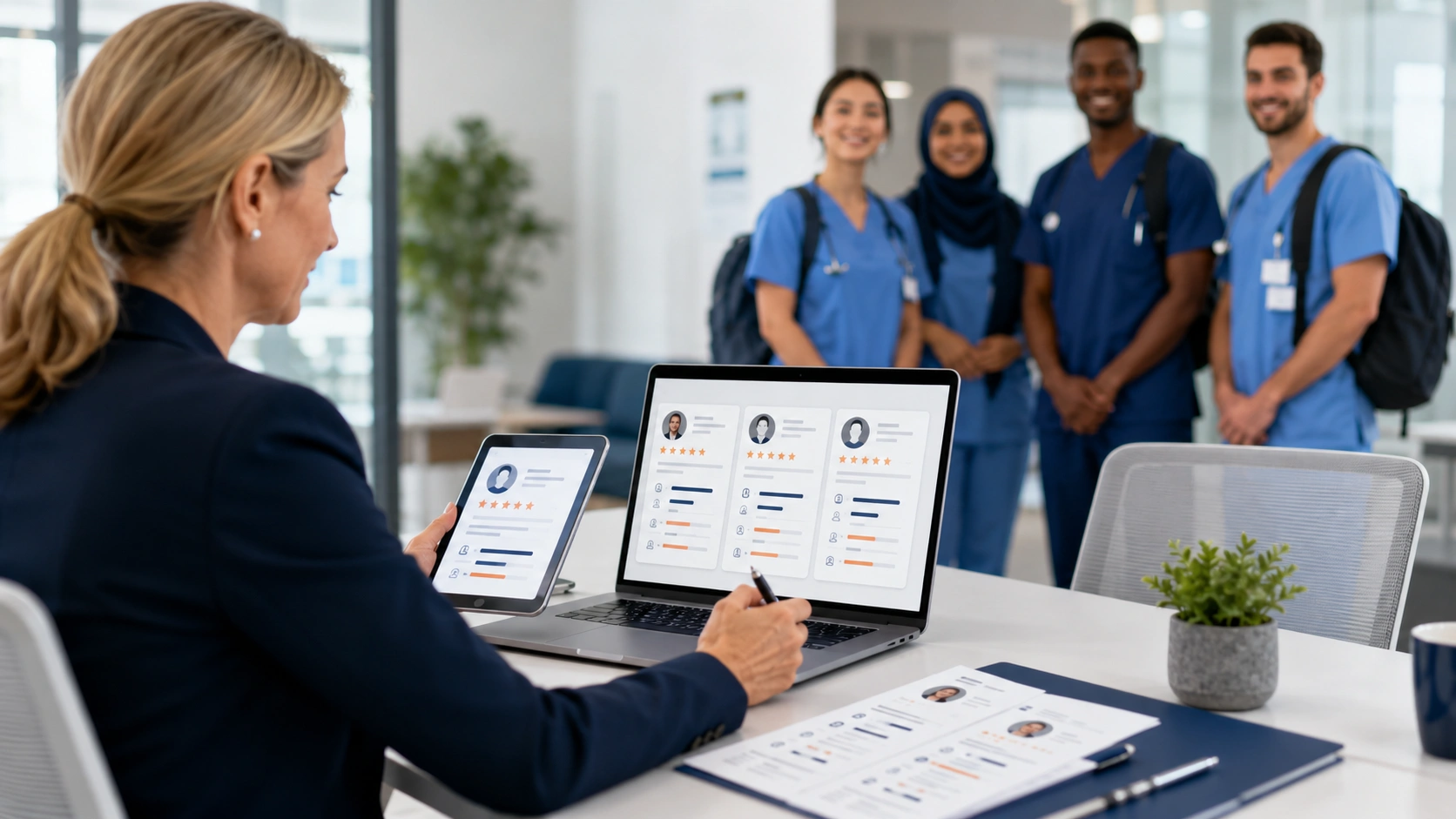
Nursing directors and HR managers in German hospitals are currently receiving more application profiles from international nurses than ever before. Placement agencies, candidate pools, speculative applications, and direct LinkedIn outreach deliver new resumes to their desks almost daily. At the same time, most institutions have less time available for pre-selection, not more.
With over six years of mediation experience, we at TalentOrbit know the pattern very well: when someone has to review 30 profiles, they ultimately decide not by quality, but by order. The first five profiles are thoroughly examined, the rest are only superficially skimmed. This is precisely where the most costly mistakes in international recruiting occur, because often the best candidates are hidden among the profiles at the back.
This guide shows what nursing management and HR should look for when reviewing profiles to make a well-informed pre-selection in under ten minutes. It summarizes what we have learned from several hundred placement interviews with hospital managers.
If a profile is marked as pre-checked, there should be three concrete verification steps behind it. If one of them is missing, the designation is an empty word.
First, the documentary review. Are original documents available (professional degree, license to practice, language certificates, proof of identity), and have they been checked for authenticity? Translations alone are not sufficient. A certified translation by a publicly appointed translator in Germany should be provided.
Secondly, the technical examination. Has an experienced registered nurse or medical examiner reviewed the profile and assessed whether the foreign training is comparable to German standards? This does not replace the later official recognition, but it covers the most important suitability questions in the pre-selection process.
Third, the language examination. Has the stated language level been proven by a standardized test, ideally telc Deutsch B1·B2 Pflege or Goethe-Zertifikat? A mere self-declaration of „B2“ without proof of examination is one of the most common stumbling blocks in the pre-selection process in the care sector.
Pay attention to the specific wording of your mediation partner. If you don't get a clear answer when asked which inspection step was taken at what time, a crucial layer is missing in the preparation.
Experienced nursing directors read a profile in a specific order. This order is not based on the typical resume structure, but on the factors that have been proven to decide the success or failure of an integration.
Whoever captures these five fields in two minutes has a better preselection quality than someone who reads the entire resume for fifteen minutes.
The most common misunderstanding in international nursing recruitment concerns language proficiency. B2 according to the Common European Framework of Reference for Languages does not automatically equate to B2 in specialized nursing terminology.
In everyday clinical practice, B2 generally means that a person can communicate adequately about the weather, family, and leisure activities. B2 nursing means that they can understand a shift handover, read nursing reports, safely implement medical orders, and discuss pain, medication, and symptoms in a differentiated way with patients. The difference between these two levels determines whether a new nurse can productively contribute to daily ward operations after three weeks or after three months.
When reviewing a profile, we recommend the following test: If the language level is indicated as „B2,“ ask for specifics. Which exam was taken? When exactly? Who administered it? A telc German B2 Nursing certificate from spring of this year is reliable. A DSH test from 2019 is not.
We also personally assess the active language proficiency in every pre-selection interview. Language certificates age, especially if the caregiver has not worked in a German-speaking environment since they were issued.
Resumes and standardized candidate profiles only capture what is quantifiable. Three suitability signals are almost always missing from the written overview, and it is precisely these that often determine whether a placement will still be valid after 18 months.
Motivation for migration. Why does this caregiver want to come to Germany? A purely economic improvement is a weaker signal for staying than family ties, long-term prospects of remaining, or a conscious decision for professional development in Germany. In our experience, caregivers with a sole focus on earnings are more mobile and change employers more frequently, often shortly after successfully passing their proficiency test.
Experience with German work culture. Has the person had prior exposure to the German work style? This could be through previous experience in a German-managed organization, through German supervisors in their home country, or through a structured preparatory program. In our experience, this factor halves the average onboarding duration.
Realistic expectations for living situation and salary. Caregivers who were not adequately informed before entering the country that the net German salary differs significantly from the gross salary, or that a shared apartment living situation can be common in the first few months, statistically tend to quit more often within the first six months. Reputable agencies explicitly document these preparatory steps in a way that is traceable.
Specifically ask your intermediary partner about these three points. If you don't get concrete answers, a crucial selection layer will be missing, which you will later pay for dearly.
We built TalentOrbit's TalentPool specifically for this pre-selection process. It exclusively shows profiles that have passed all three mentioned verification steps: documentary, technical, and linguistic. The filters cover exactly the five fields that are truly decisive in pre-selection: profession and specialization, German language skills, professional experience, field of expertise, availability, and spoken languages.
All profiles in the TalentPool are anonymized in compliance with GDPR. You will receive sufficient information for a well-founded professional pre-selection without personal data of the candidates being disclosed prior to your explicit request.
Once we've identified a suitable candidate, we'll send you a full, de-anonymized overview within 24 hours, including their current recognition status, earliest availability date, and a suggestion for an initial meeting.
→ View current nurse profiles in the Talent Pool
For questions about the application in your home, you can reach our team at +49 (0)2173 26538 70 or by email at info@talentorbit.de.