


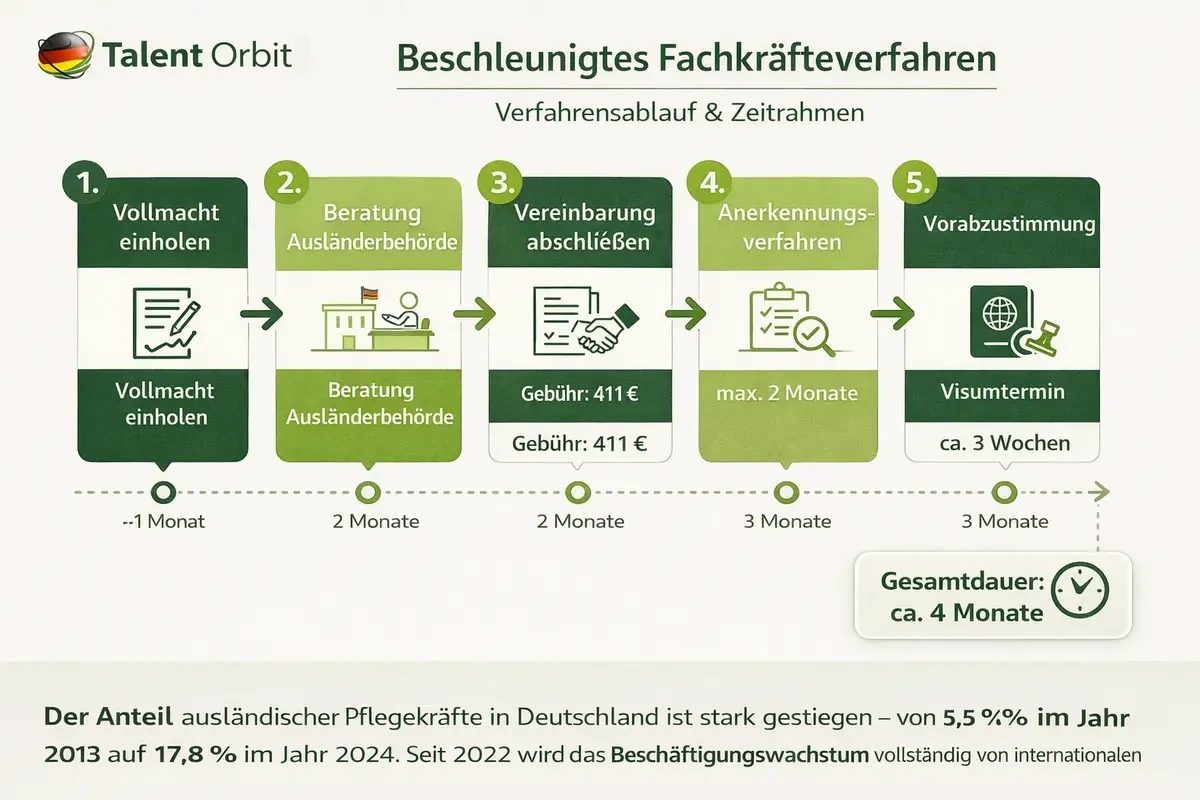
Short answer for employers: International nurses can be recruited via the Triple Win program, the Western Balkans scheme or private agencies. Expect total costs of €15,000-30,000 per skilled worker and a lead time of 6-12 months. The accelerated skilled worker procedure (€411 fee) can shorten the visa process to approx. 4 months.
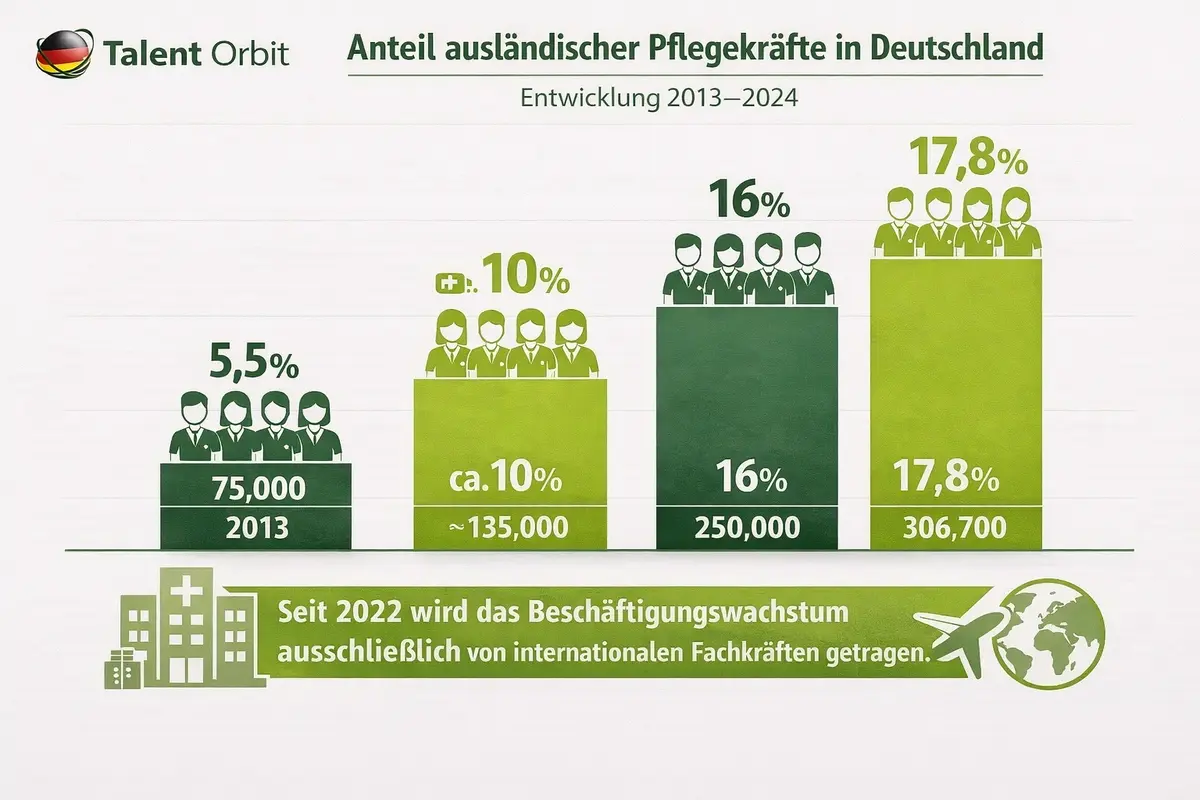
The shortage of skilled workers in the German care sector is reaching critical proportions. According to Integration media service (2025) more than 306,700 foreign nursing staff were working in Germany in 2024 - this corresponds to 17.8 percent of the approximately 1.7 million people employed in nursing professions. Almost one in five nurses is now a foreign national.
A study by the Institute for Employment Research (IAB, October 2024) shows: Since 2022, employment growth in the care sector has been driven exclusively by foreign employees, while the number of German care workers has been declining.
For hospitals, nursing homes and outpatient care services, this means: Nursing operations cannot be maintained without the systematic recruitment of international nursing staff. This guide is aimed at management, nursing service managers and HR departments who want to recruit nursing staff from abroad and need a structured overview of the legal framework, qualification requirements and practical implementation.
About this guide: This guide was developed by TalentOrbit International GmbH specialized in the placement of international healthcare professionals from the Philippines, India, Kazakhstan and Kyrgyzstan. Our expertise is based on practical support for employers throughout the entire recruitment and integration process.
Demographic trends are exacerbating the situation. According to the Nursing staff forecast by the Federal Statistical Office the demand for nursing staff is expected to rise to 2.15 million by 2049. There could then be a shortage of between 280,000 and 690,000 nursing staff.
Key figures at a glance:
| Key figure | Value (source) |
| Employees in care professions (2024) | approx. 1.7 million (BA) |
| Of which foreign nursing staff | 306,700 / 17.8% (BA 2025) |
| Proportion of foreigners in geriatric care | 21.7% (IAB 2024) |
| Percentage of foreigners in nursing care | 16.5% (IAB 2024) |
| Projected shortage until 2049 | 280,000-690,000 (Destatis) |
Sources: Federal Employment Agency, Focus on the Labor Market 2024; IAB Research Report 22/2024; Federal Statistical Office, Press Release No. 033/2024
Covering the acute need for skilled workers: According to the Federal Employment Agency, it takes an average of over 200 days to fill a vacancy in geriatric care with domestic applicants. International specialists can close this gap in a predictable manner.
Long-term personnel planning: Unlike temporary staffing, the direct employment of international nursing staff enables sustainable personnel planning. Find out more about the Recruitment process at TalentOrbit.
Cultural enrichment: Teams benefit from different perspectives and experiences - especially when caring for patients and residents with a migration background.
The reformed Skilled Immigration Act has gradually come into force since November 2023 and was fully implemented on June 1, 2024. For employers who Hiring nursing staff from abroad This results in significant simplifications for those who wish to do so.
Pillar 1 - Skilled workers with recognized qualifications: Persons with a professional qualification recognized in Germany can pursue any qualified occupation. For nurses as a regulated profession, the recognition requirement continues to apply.
Pillar 2 - Professional experience: Skilled workers with at least two years of professional experience and a professional qualification recognized by the state in their country of origin can enter the country under simplified conditions, even if recognition in Germany is still pending.
Pillar 3 - Potential (opportunity map): The new opportunity card makes it possible to enter the country to look for work on the basis of a points system.
Recognition partnership: Skilled workers can now enter Germany and start the recognition procedure after arrival. Prerequisite: employment contract, agreement on joint implementation of recognition, German language skills A2. More information on the Legal page of TalentOrbit.
Nursing assistants from third countries: For the first time, a separate residence permit has been created for nursing assistants. People with a nursing qualification below the three-year specialist qualification can be employed in the health and care sector.
Facilitated family reunification: Skilled workers benefit from simplified regulations for family reunification. Proof of sufficient living space is not required.
The nursing profession is regulated in Germany. This means that anyone wishing to work as an international nurse in Germany requires a state license to practice the profession in accordance with the Nursing Professions Act (PflBG).
| Recruitment route | Costs | Duration | Special feature |
| Triple Win (ZAV/GIZ) | 5.000-7.000 € | 12-18 Mon. | State, ethical, language course incl. |
| Private agency | 8.000-15.000 € | 6-12 Mon. | Flexible, full service possible |
| Western Balkans regulation | Variable | 3-6 Mon. | 50,000 visas/year, recognition required separately |
| Direct recruitment | 3.000-8.000 € | 6-18 Mon. | High internal costs, expertise required |
⚠️ Important note on the Western Balkans regulation: The Western Balkans regulation facilitates entry and residence, but does NOT replace the obligation to obtain recognition for regulated professions such as nurses. It is therefore primarily suitable as a residence bridge during the recognition procedure or for employment as a care assistant.
The Accelerated skilled worker procedures according to § 81a AufenthG is an important instrument for attracting qualified nursing staff to Germany more quickly.
Costs: The fee for the accelerated skilled worker procedure is as follows Make it in Germany currently 411 euros. These costs are also incurred in the event of rejection.
Recruiting international nursing staff requires considerable investment. A transparent cost overview helps with budget planning:
| Cost type | Estimated amount |
| Mediation (e.g. Triple Win) | 5.000-7.000 € |
| Accelerated skilled worker procedure | 411 € |
| Recognition procedure + translations | 500-1.500 € |
| Knowledge test (preparation + examination) | 1.500-3.000 € |
| or: Adaptation course | 3.000-10.000 € |
| Language courses in Germany | 2.000-5.000 € |
| Flight and initial equipment | 1.000-2.000 € |
| Housing support (first few months) | 1.500-3.000 € |
| TOTAL INVESTMENT PER SPECIALIST | 15.000-30.000 € |
Return on investment: Despite high initial investments, recruitment pays off: an unfilled nursing position often costs €40,000-60,000 per year due to temporary work or a reduction in services. International specialists often show high employer loyalty and enable long-term personnel planning.
Nursing professionals from EU/EEA countries generally receive automatic recognition. The most important EU countries of origin are Poland (approx. 9,700 employees), Croatia (approx. 8,700) and Romania (approx. 8,000). According to IAB Study 2024 most nursing staff in the EU come from these three countries.
Philippines: Academic 4-year degree (B.Sc. Nursing), good knowledge of English, active recruitment via Triple Win. Read more: Career opportunities for nursing staff from the Philippines
India (Kerala, Telangana): Over 8,800 nurses in the German healthcare sector (as of 2024), fast-growing recruitment country with a strong nursing culture.
Western Balkan states: Over 51,000 nursing staff from Albania, Bosnia-Herzegovina, Kosovo, Montenegro, North Macedonia and Serbia are already working in Germany. Bosnia-Herzegovina is also part of the Triple Win program.
TalentOrbit places specialists from the Philippines, India, Kazakhstan and Kyrgyzstan - Countries with well-trained nursing staff and high motivation for a career in Germany.
Successful integration is at least as important as recruitment itself. Without sustainable integration measures, there is a risk of high fluctuation and dissatisfaction. TalentOrbit offers comprehensive information on Living in Germany for international specialists.
Before recruitment:
During the procedure:
After arrival:
Recruiting international nursing staff is no longer an option for German hospitals and nursing homes - it is a strategic necessity. Demographic change, the declining number of German nursing staff and the unbroken shortage of skilled workers make nursing staff from abroad an indispensable pillar of the German healthcare system.
The legal framework has improved significantly thanks to the Skilled Immigration Act. However, anyone who only sees international nursing staff as a quick solution to staff shortages will be disappointed. Success requires staying power, considerable investment and a genuine commitment to integrating new team members.
Next step: Have your personnel requirements checked TalentOrbit International GmbH supports you in the recruitment and integration of international nursing professionals - from needs analysis to successful integration.
➡️ Contact: www.talentorbit.de/kontakt | +49 (0) 2173 265 3870 | info@talentorbit.de
This guide was created in January 2025 and takes into account the legal situation of the Skilled Immigration Act as amended in June 2024. For the latest developments, visit www.talentorbit.de/blog.