

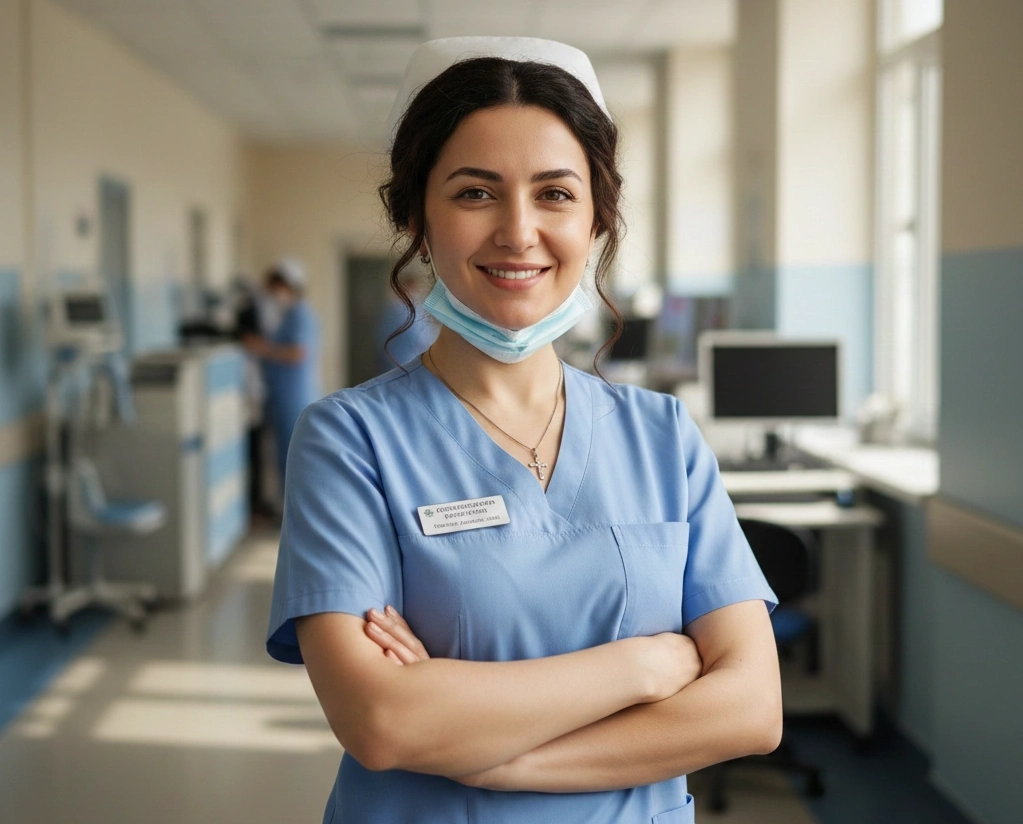
Georgia, the small country in the South Caucasus between Europe and Asia, is increasingly becoming the focus of German HR managers in the healthcare sector. With a population of around 3.7 million people and a long tradition of medical training, the country offers qualified nurses who can represent a real alternative to the better-known recruiting countries.
Georgian healthcare education has undergone fundamental modernization over the last two decades. Since joining the Bologna Process, the higher education system has been aligned with European standards. The accreditation authority NCEQE (National Center for Educational Quality Enhancement) has been a full member of the European Association for Quality Assurance in Higher Education (ENQA) since 2019 and was recognized by the World Federation for Medical Education (WFME) in 2018. These are not just empty titles, but proof that Georgian higher education is assessed according to international standards.
Was Recruiter außerdem wissen sollten: Georgien steht nicht auf der WHO-Liste der Länder mit kritischem Fachkräftemangel im Gesundheitswesen. Die Rekrutierung von dort ist also ethisch unbedenklich und unterliegt keinen Beschränkungen nach §38 BeschV.
Nursing training in Georgia is an academic Bachelor's degree program (Bachelor of Nursing, B.N.) and includes:
The practical component is considerable: around 90 to 112 ECTS are accounted for by clinical practice and profile-related courses. Clinical training takes place in hospitals, polyclinics, outpatient facilities and long-term care facilities.
The curriculum at Georgian universities such as the Tbilisi State Medical University, the University of Georgia or the Caucasus International University covers a broad spectrum:
Basic subjects:
Nursing modules:
Additional competencies:
Georgian nursing training uses modern teaching methods that should be familiar to German recruiters:
The examination is based on a 100-point system, which corresponds to the ECTS grading system: A (91-100), B (81-90), C (71-80), D (61-70), E (51-60). This should make it easier to classify the course for later recognition.
The key question for recruiters: How does Georgian training relate to the German qualification as a nursing specialist?
| Feature | Germany | Georgia |
| Training type | Vocational school (generalist since 2020) | Academic (Bachelor) |
| Duration | 3 years | 4 years |
| Theory | 2,100 hours | approx. 1,800-2,000 hours (estimated) |
| Practice | 2,500 hours | 90-112 ECTS (approx. 2,250-2,800 hours) |
| Conclusion | State examination | Bachelor of Nursing (B.N.) |
| Qualification level | DQR 4 | EQF/NQF 6 (Bachelor) |
The generalist nursing specialist training in Germany since 2020 includes assignments in:
These areas are also covered in the Georgian training. The practical assignments take place under the guidance of experienced mentors, comparable to German practical guidance.
Academic vs. vocational school approach: Georgian training is a fully-fledged university course with academic work, research projects and a Bachelor's thesis. This can be an advantage if nurses are later to be employed in areas such as quality management, practice guidance or nursing science.
Geriatric care: In Germany, geriatric care is a central component of generalist training. Although there is a module on geriatric care in Georgia, long-term inpatient care is traditionally less important there. Nursing staff from Georgia often have less experience with German nursing home structures.
Language of training: Many Georgian nursing programs are offered in English to attract international students. This means that some graduates may be proficient in English, but not necessarily in German or Georgian.
Georgia is a third country, so automatic recognition is not possible. Nurses from Georgia must undergo the regular recognition procedure.
Recognition is granted by the regional council or state examination office of the federal state in which employment is to be taken up. Once granted, recognition is valid nationwide.
Full recognition: Rather rare in the case of third-country qualifications, but possible if the training does not show any significant differences.
Deficit notice with compensation measure: The standard case. The authority determines which content or number of hours are missing. The caregiver can then choose between
Waiver of equivalence test: Since 2024, nursing staff have been able to voluntarily waive the individual examination and go straight into an adaptation period. This can speed up the process, but may mean longer compensation measures.
Based on the curricula, it is to be expected that the following areas could be identified as deficits:
Georgian is one of the Kartvelian languages and is not related to any European language. This means that learning German is not an easy task for Georgians. In contrast to speakers of Slavic languages, there are no related vocabulary words or similar grammar structures.
However, many Georgian nursing staff are young, well trained and motivated. Knowledge of English is widespread, which can help with specialist vocabulary. Realistic expectation: 12-18 months of intensive German learning up to B2 level.
Invest in language courses before entering the country (at least A2, better B1) and continue language training after arrival. Experience has shown that the combination of language course and accompanied practical placement works best.
Recognition partnership (since 2024): Employers can conclude a recognition partnership with the care worker. This enables entry with A2 language skills, and recognition then accompanies employment. The nurse initially works as a care assistant.
Employers can apply to the Immigration Office for the accelerated skilled worker procedure in accordance with §81a AufenthG. Advantages:
The German Embassy in Tbilisi is responsible for visa matters.
Direct recruitment: Contact Georgian universities such as Tbilisi State Medical University or the University of Georgia. These often have career services that can help with placement.
Recruitment agencies: Some agencies have started to specialize in the Georgian market. Look out for the „Fair Recruitment Care Germany“ seal of approval.
DeFa (German Agency for Healthcare and Nursing Professions): Can advise on structuring the recruitment process, but does not place directly from Georgia.
Successful integration requires:
By comparison, the median income for care workers in Georgia is around 280 euros per month (774 GEL). German salaries are therefore many times higher, which is a strong motivation to migrate. At the same time, this means that Georgian care workers are often initially dependent on savings until the first salaries are received. Support in bridging the gap can strengthen the bond.
Basic academic education: The Bachelor's degree means a higher formal qualification level. Graduates are accustomed to scientific work and can reflect on complex contexts.
Theoretical foundation: The comprehensive training in basic subjects such as anatomy, pathology and pharmacology creates a solid understanding of medical contexts.
Modern teaching methods: Simulation, OSCE, problem-based learning are no foreign words. Many graduates are familiar with patient-centered, evidence-based approaches.
English language skills: Can facilitate access to international specialist literature and be helpful in communicating with patients from other countries.
Motivation: The decision to migrate to Germany is often well-considered. Those who take this path are usually highly self-motivated.
Language barrier: German is difficult for Georgians to learn. Patience and ongoing language support are essential.
Geriatric care: German geriatric care with its specific concepts (biography work, validation, activation) requires familiarization.
System knowledge: The German healthcare system with its special features (SGB V, SGB XI, care levels, MDK examinations) must be learned.
Documentation culture: The detailed care documentation according to German standards differs from Georgian practices.
Cultural adaptation: Different ideas of hierarchy, teamwork and patient autonomy require adaptation on both sides.
Georgia is not a classic recruitment country like the Philippines, India or the Western Balkans. The infrastructure for large-scale recruitment programs does not yet exist to the same extent. If you want to recruit Georgian nurses, you currently have to be more proactive.
On the other hand, Georgia offers well-trained, motivated specialists with an academic background. The country is geographically closer than many Asian countries of origin, which makes it easier to travel and visit home. The cultural influence is European, and Georgia's political orientation is clearly towards Europe.
For employers who are prepared to invest in individual recruitment and careful integration, Georgian nurses can be a valuable addition to the team. The academic training also qualifies them for tasks beyond direct nursing care: as practice supervisors, in quality assurance or in nursing management.
The recommendation: Start with a small pilot project. Recruit two to three nursing staff, monitor their integration intensively and evaluate the experience before expanding the commitment.
Offizielle Portale:
Georgische Institutionen:
Gütesiegel und ethische Rekrutierung:
Dieser Artikel richtet sich an Personalverantwortliche und Recruiter in deutschen Krankenhäusern, Pflegeheimen und ambulanten Pflegediensten. Er ersetzt keine individuelle Rechtsberatung zum Aufenthalts- oder Berufsanerkennungsrecht.