

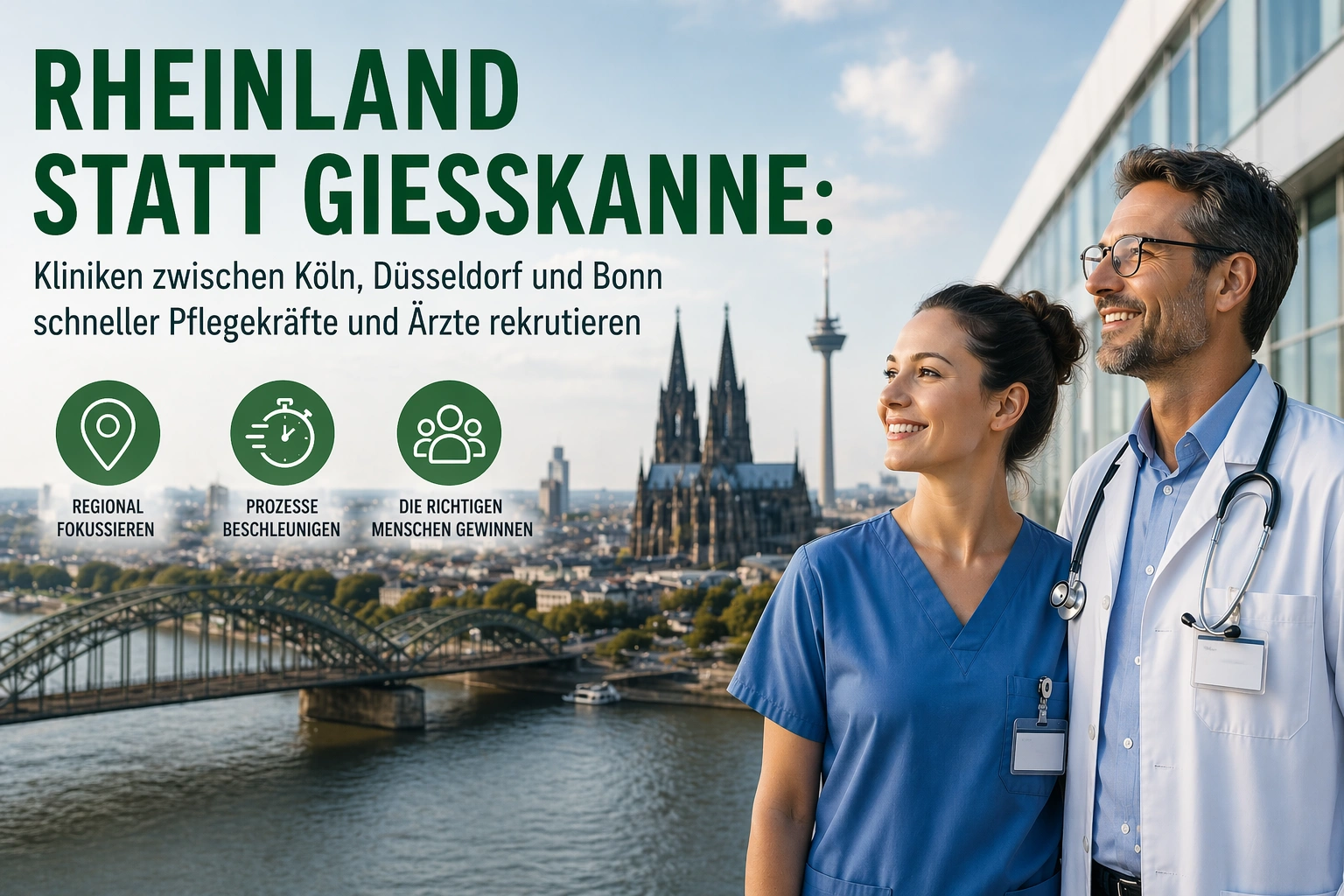
Most clinics in the Rhineland do not have a reach problem. Job advertisements run, budgets are available, applications are received. And yet, wards remain understaffed for weeks or months.
What is the reason for that?
In practice, a recurring pattern emerges. Applications are available, but handling them stalls. Feedback is delayed, departments respond late, and decisions are postponed. While internal reviews are still underway, the candidate has long since decided otherwise.
In the Cologne, Düsseldorf, and Bonn region, the labor market is closely intertwined. Caregivers and doctors apply to multiple hospitals simultaneously, often within a few days. Those who don't respond bindingly during this phase lose out—regardless of how good the offer actually is.
An example from everyday hospital life: A certified nurse applies to three facilities within a 30-kilometer radius at the same time. Two respond within 48 hours and invite her for an interview. The third contacts her after eight days, asking for patience. By then, the decision has long been made.
Therefore, the right question is no longer „How do we reach more applicants?”, but rather: How do we attract the right people faster, before others do?
This change in perspective fundamentally alters recruiting. Away from the broadest possible visibility. Towards control, regional focus, and commitment. This is precisely where the difference lies between clinics that permanently struggle with vacancies and those that reliably fill their positions despite competition.
Those recruiting in Cologne, Düsseldorf, and Bonn are not operating in an ordinary market. University hospitals, municipal maximum care providers, private hospital groups, and highly specialized medical centers compete for the same skilled professionals in a small area. For applicants, this means choice – and this choice is available at any time.
Just ten years ago, changing hospitals often meant major changes: moving house, a new school route for the children, longer decision-making periods. Today, a change within a radius of 20 to 40 kilometers is often enough to get noticeably different working conditions. Nurses move along the commuter routes of Cologne-Bonn or Düsseldorf-Neuss, doctors focus on further training opportunities and workload, and part-time employees optimize their working hours, even accepting a longer commute for it.
This makes exchange decisions more pragmatic—and faster.
What an employer considers „quite decent” internally, is often assessed differently by colleagues and on review platforms. Information that used to leak out only after a three-week probationary period is now available on a phone before the cover letter.
Applicants clarify central questions before applying:
This means: Clinic A and Clinic B are not only competing for the same applicants—they're competing for the same break room conversations.
In this market, „solid” is no longer enough. Those who are not recognizably different become automatically interchangeable. Multiple bids often exist concurrently, decisions are made at short notice, and soft factors gain importance.
Three consequences for recruiting managers:
Those who ignore this dynamic don't lose because too little is done. They lose because work is done too slowly and too inaccurately.
Many clinics do nothing wrong, formally speaking. They run ads, maintain career pages, attend job fairs, and hire headhunters. And yet, the results fall short of expectations. The problem goes deeper: most measures are designed for reach, not for speed of decision-making or precision fit.
A common pattern is quickly described. Formulate, publish on multiple portals, wait for applications. This works in stagnant markets. In the Rhineland, it leads to massive wasted reach because the same target audience is simultaneously addressed by six other companies with almost identical messages.
Application received. HR reviews documents. Forwarded to the specialist department. Internal coordination. Feedback to applicant. Logically sound on paper. In reality, delays occur precisely at the transition points: handoffs are missed, feedback is missing, priorities are unclear. This process is not visible to applicants—only the result: silence.
When positions are hard to fill, the reach is often increased first. Additional job portals, more budget, external service providers. In the short term, the number of applications increases. However, the structural weaknesses in the process persist — and now they affect a larger number of applicants. The bottleneck shifts, it doesn't disappear.
The solution usually lies not in additional measures, but in better priorities: regional focus, clear responsibilities, binding response times, fewer process steps. Only when these fundamentals are in place do advertisements have an effect.
„Looking for talent in the Rhineland” sounds obvious, but it's not the whole story. The labor market between Cologne, Düsseldorf, and Bonn is not a uniform area. It's made up of many small sub-markets with their own dynamics. Those who want to recruit faster must understand these differences and use them strategically.
In conversations with nurses, the same pattern keeps emerging: the commute is often more important than a slightly higher salary. Fifteen minutes less travel time, a reliable parking spot, or better public transport connections can be the deciding factor – even if another facility would be formally more attractive.
So the question is not only, was You offer. Rather how well you are reachable.
Most clinics recruit the majority of their staff from a clearly defined radius. In urban areas, this is often 20 to 40 kilometers, and in rural surroundings, it can be more. Within this radius, applicants move along transportation routes, orient themselves by residential areas rather than city limits, and consciously avoid heavily congested commute routes.
A clinic in the Bonn area faced a common problem: intense competition from large facilities in Cologne. The original strategy was broad: targeting the entire Rhineland without regional prioritization. The result: significant wasted reach, a low conversion rate, and high cost per hire.
Following a realignment, a more targeted approach was taken. The focus shifted to surrounding, less contested regions. There was a targeted outreach to nursing staff who were already commuting long distances to Cologne. The emphasis was on short commutes and predictable working hours, rather than comparisons of size with university hospitals.
Instead of more applications, we got better ones: higher completion rate, faster decisions, less competition pressure in the selection process.
In comparable projects, it's regularly observed that focusing on clearly defined catchment areas noticeably shortens staffing processes while simultaneously improving the hiring rate. The effect isn't due to more applications, but rather to more suitable ones.
The crucial step is to structure your own market. Three questions help:
This allows for a simple prioritization: A-areas with a high probability of suitable applications, B-areas as potential expansion, and C-areas with low relevance. The approach differs accordingly – a clinic in Leverkusen will make a different case to candidates from the Bergisches Land region than to those from Cologne.
Many homes are planned along administrative boundaries. However, these are of little importance to applicants. Commuting times, living conditions, and individual priorities are decisive. A nurse from the Bonn region is more likely to opt for a easily accessible clinic outside the city than for a facility in downtown Cologne with a 45-minute commute.
A microregional perspective doesn't provide more volume. It provides a higher degree of accuracy. And that decides how quickly a position is actually filled.
Many clinics formulate their needs too broadly. „We are looking for nurses.” „We need doctors.” Internally, this is a pragmatic simplification. In recruiting, this becomes a problem, because from the applicants' perspective, everything blurs – and what is not tailored to anyone in particular doesn't seem particularly inviting to anyone either.
Within nursing, motivation, expectations, and willingness to change differ considerably. Three groups clearly demonstrate this.
Career starters are looking for orientation and structured onboarding. They place a high value on team atmosphere, guidance, and the question of whether they will be overwhelmed in their first year. However, they also switch jobs relatively quickly if expectations are not met.
Experienced specialists value reliable procedures, a reasonable staff-to-client ratio, and clear responsibilities. They rarely switch, and when they do, it's with purpose—they compare details, not brochures.
Re-entrants and part-time workers Prioritize predictability and compatibility. They are sensitive to short-notice schedule changes and are often willing to be flexible if the framework is specific — afternoon shifts, fixed weekends off, no on-call duty.
Anyone who wants to reach these groups with a single job advertisement will not reach anyone properly.
Even in the medical field, generalizations fall short. Resident physicians pay special attention to the continuing education curriculum, supervision, and workload. They actively compare between facilities and react quickly to specific offers. Specialist doctors are interested in specialization opportunities, development prospects, and the actual decision-making power within their department. They change jobs less frequently, but when they do, they have clear expectations.
One message does not reach both groups equally well — and the wrong message reaches neither.
Many companies are increasingly relying on international recruitment. The demand and qualifications are there – but so are the expectations of the employer. What's crucial here are not so much technical questions as structured recognition processes, professional language training, and support in everyday life: housing, dealing with authorities, settling in. Those who don't clearly address these points will lose candidates early on.
Across all groups, a pattern emerges: general statements are ignored, concrete information is sought. Recurring questions include:
In practice, these questions are more decisive for commitments than any list of benefits.
An effective recruiting strategy differentiates itself in two ways: internally in planning and externally in outreach. Specifically, this means: your own ads for different target groups, different focuses depending on the profile, and adapted channels. An advertisement for career starters should be structured differently than one for experienced intensive care nurses – both in terms of content and language.
The effort is higher. But so is the effect: higher response rates, more suitable applications, faster decisions. In a competitive market, it doesn't matter how many people see an ad. It matters how many actually feel addressed.
In recruiting between Cologne, Düsseldorf, and Bonn, one factor is systematically underestimated: time. Many clinics invest in better ads, new channels, external service providers—and thereby overlook that most candidates are not lost because the offer is bad. But because the response comes too late.
Qualified nurses often have multiple options simultaneously in the Rhineland. Initial interviews take place within a few days, and decisions are often made within one to two weeks. In many cases, responding after ten days doesn't mean you're „a little late” – it means you're already out of the running.
The gap between typical clinic processes and applicant expectations is clear in the following overview:
| Process step | Common duration in clinics | Applicant expectations |
|---|---|---|
| Acknowledge receipt | 2–5 days | under 24 hours |
| Invitation to talk | 5–10 days | 1-3 days |
| Decision after discussion | 1-2 weeks | a few days |
| Contract dispatch | 3–10 days | 2-4 days |
The gap isn't a detail. It determines whether a position in the company is filled or goes to the competition.
The causes are rarely technical. They are organizational: unclear decision-making authority, lack of prioritization of open positions, coordination across multiple levels, uncertainty within the specialist departments about their own mandate. Speed is not actively controlled in these structures—it happens randomly or not at all.
From the applicants' perspective, the application process is not an administrative sequence, but an experience. Four breaking points are particularly critical.
The application itself. Many forms are longer than necessary, request uploads of complex documents, and have limited functionality on smartphones. Especially in the care sector, a considerable portion of interested parties abandon the process before it even properly begins.
The first feedback. Often after submitting, nothing happens. Automatic acknowledgments do not replace a genuine response. Anyone who doesn't provide personal feedback with a concrete next step here loses credibility.
Finding a date. Coordinating meeting times with multiple participants is an underestimated bottleneck. Three appointment chains of two business days each can quickly lead to ten days of waiting time.
The decision. After a conversation, candidates expect clarity. In many companies, a new loop begins here: internal coordination, follow-up questions, uncertainty in evaluation. Meanwhile, parallel processes continue, often faster.
Each of these points seems manageable on its own. In sum, a clear effect emerges: lower closing rates, longer filling times, and increasing frustration on both sides.
Houses that consistently occupy faster in the Rhineland do not work with more complex systems. They work with clearer rules.
A common misconception: recruiting pace is seen as the responsibility of the HR department. In practice, it largely depends on department heads, chief physicians, and the internal coordination culture. If feedback from the specialist departments isn't received, HR cannot speed up the process.
The real competitive advantage is thus simply described: Between two clinics with similar framework conditions, the deciding factor in case of doubt is not salary, not equipment, not size. But rather, who puts a clear offer on the table first.
„Great team,” „modern equipment,” „attractive compensation” — almost every clinic website in the Rhineland uses these phrases. The problem isn't that the statements are false. The problem is that they don't help with a single decision.
From a candidate's perspective, most hospitals seem interchangeable. Differences are not discernible, and promises remain abstract. In a highly comparable market, decisions are then made not on the basis of communication, but on the basis of chance, speed, or a friendly tone on the phone.
Standard phrases have three weaknesses. They are not verifiable – what does „good team” actually mean? They are not differentiating – every clinic can use the same words. And they are not decision-relevant – they don't answer any of the concrete questions that matter in everyday life.
The difference lies in the precision of the statements. Some examples:
| General Statement | Concrete, effective statement |
|---|---|
| „Good team” | „Permanent teams on the ward, average length of service 7 years” |
| „Modern Work Environment” | „Digital documentation at all stages, no duplicate entries” |
| „Attractive working hours” | „Schedules four weeks in advance, binding” |
| „Structured onboarding” | „Six-week onboarding with a dedicated mentor, documented onboarding plan” |
| „Further training possible” | „Annual training budget of X € per employee, 5 days paid leave” |
Concrete statements are more vulnerable — and that's exactly why they are more credible.
In the Rhineland, salaries are transparent. Pay scales are known, and differences between employers are openly discussed. Most applicants have a realistic understanding. This leads to a sober assessment: a slightly higher salary might prompt a move, but rarely ensures long-term commitment. Therefore, what's crucial is not so much the absolute amount, but its position within the overall package—predictability, actual workload, and day-to-day reliability.
In conversations with nursing and medical teams, one point keeps coming up: direct leadership. Turnover decisions are often linked to the inaccessibility of supervisors, unclear decisions, and a lack of support in daily work. Conversely, stable, reliable leadership is more binding than any single benefit.
For recruiting, this means that what doesn't work internally cannot be permanently compensated for externally. The most beautiful advertisement becomes a lie after two months in the company.
A common misconception is the separation of recruiting and retention. In practice, the two are intertwined. Every unfilled position arises from growth or turnover. While growth is usually planned, turnover often results from avoidable factors—overload, lack of prospects, unclear communication. Those who don't address these causes permanently increase recruiting pressure.
The economic perspective is clear: every new hire incurs costs for advertising, selection, onboarding, and the loss of productivity during the transition phase. If employees leave again after nine months, this cycle repeats itself. Recruiting faster is important. Hiring sustainably is crucial.
Three characteristics appear regularly:
Companies that can do this don't recruit any less — but they recruit under significantly better conditions.
For many clinics in the Cologne, Düsseldorf, and Bonn regions, international recruitment is no longer a niche topic. In both nursing and medical services, it is increasingly seen as a necessary component of personnel strategy. Expectations are high—filling open positions faster, structurally compensating for bottlenecks, and building more stable teams in the medium term.
However, in practice, international recruitment does not work automatically. And it only accelerates processes if the internal prerequisites are met.
Many clinics are launching initiatives focused on attracting candidates—and underestimate the phase that follows. Bottlenecks typically arise with the recognition of professional qualifications, unclear internal responsibilities, lack of coordination with immigration authorities and district governments, and delays with visas and documents. The time between an offer and the actual start of work is often six to twelve months.
Even more critical than the start is the time afterward. International specialists bring motivation and qualifications with them, but encounter a complex environment: a new language, different work processes, unfamiliar team structures, and German bureaucracy. Without structured support, problems quickly arise – uncertainty in daily work, misunderstandings within the team, and increased dropout rates in the first six months.
Institutions that have successfully implemented international recruitment treat it as a distinct, structured process, not a one-off initiative. This includes clear internal responsibilities with central coordination, standardized procedures for recognition and onboarding, close support in the initial months, and language training that goes significantly beyond the minimum. The reliability of these procedures is more important than their complexity.
International recruitment is not a short-term lever. Longer lead times, higher organizational effort, and additional coordination with partners and authorities are part of the model. It is therefore less suitable for quickly filling acute vacancies – but rather as a building block for medium-term staff stabilization.
Successful companies link both: regional recruitment for short-term assignments and international recruitment for structural supplementation. This creates a balanced approach that reflects both speed and sustainability. Without stable internal processes, sufficient resources for integration, and realistic timelines, international recruitment, on the other hand, quickly becomes an additional bottleneck rather than a solution.
From our project experience, it is clear that successful international recruitment is not decided during candidate selection, but in the subsequent phases—recognition, visas, onboarding, and integration. Clinics that manage these steps in a structured way achieve significantly more stable staffing levels.
When recruiting processes stall, the first instinct is often obvious: implement a new system. Applicant tracking software, automated communication, digital interfaces. The expectation behind this is clear: more technology should lead to more speed.
In practice, it’s a different story. It’s not a lack of tools that holds most clinics in the Rhineland back, but unclear processes.
Many organizations are introducing new software without changing the underlying processes. Applications are still forwarded multiple times, decisions remain unclearly distributed, and feedback is delayed despite digital capture. The process is then digitally mapped—but not faster. Often, it's even more complicated because a software training is now also necessary.
When used correctly, systems can provide targeted support. The key is that they simplify existing processes — not just document them.
Meaningful areas of application are:
Some problems are resistant to software. Lack of decisiveness, unclear responsibilities, and poor prioritization are organizational issues, not technical ones. If feedback from business departments is nonexistent, no applicant tracking system in the world will speed up the process.
More tools don't automatically mean better results. Additional interfaces increase complexity, training efforts rise, and processes become less clear. Many successful clinics deliberately work with a few, clearly defined tools and focus on their consistent use.
The order should therefore always be the same: define processes, clarify responsibilities, only then select technical support. Technology works where there is clarity. In unclear processes, it amplifies existing problems.
Strategies are important, but they only have an impact when implemented. Many clinics know where their problems lie but fail at prioritization. The following roadmap is designed to achieve tangible results with manageable effort.
The first phase is not about projects. It's about immediately effective adjustments to the existing process.
Concrete measures:
Expected effect: Initial reductions in time-to-response and time-to-hire, without structural interventions.
Building on the initial adjustments, systematic alignment follows.
Concrete measures:
Expected effect: Higher completion rates, less coordination effort, more stable processes.
The third phase is about substance and positioning.
Concrete measures:
Expected effect: Sustainable reduction of time-to-hire, better predictability, less reliance on external campaigns.
The plan deliberately forgoes large projects. It focuses on the area with the greatest leverage: existing processes, decision-making speed, and focus. In a market like the Rhineland between Cologne, Düsseldorf, and Bonn, small, consistently implemented steps are experience shows to be more effective than large initiatives that fizzle out after six months.
Clinics in the Rhineland are not facing the challenge of doing too little. Rather, it's about consistently implementing the right things. Recruiting faster means prioritizing more clearly, making processes binding, and clearly defining responsibilities.
Reach alone doesn't solve the problem. What happens after an application is received is crucial. Those who don't align their internal processes for speed and clarity won't achieve better results, even with higher budgets. Conversely, clinics that have their processes under control fill positions faster – and more stably.
The difference isn't in the market. It's in how that market is worked.
The actual time to hire varies greatly by institution and process quality. In average clinics in the Cologne, Düsseldorf, and Bonn region, staffing times for nursing specialists currently often range between six and twelve weeks. Institutions with streamlined processes and clear decision-making authority regularly fill comparable positions in three to five weeks. The difference almost always lies in response time and decision-making speed, not in the volume of applications.
The costs of a vacancy are usually underestimated. They consist of the costs of downtime for temporary staff or overtime, the loss of productivity within the team, direct recruiting expenses, and – particularly relevant – the follow-on risk of increased turnover due to overload. An unfurnished nursing position can quickly cost a clinic in the Rhineland between 300 and 600 euros per day, depending on the specialty. For longer vacancies, investments in process improvements quickly pay for themselves.
As the industry standard for effective recruiting, 48 hours is considered the maximum — by then, candidates should receive personalized feedback, not just an automated confirmation of receipt. Anyone taking longer risks the candidate receiving an offer from another company during that time and mentally committing to it. For particularly competitive profiles (intensive care, surgery, certain specialist groups), the timeframe is often even less than 48 hours.
Not technology, not budget, not size. The main difference lies in three organizational factors: clear decision-making authority at the departmental level, binding response times for all stakeholders, and fixed structures like weekly interview slots. Fast-moving companies have fewer process steps—and fewer people who individually approve each of those steps.
International recruitment is not a substitute for regional recruiting, but rather a structural addition. It is particularly suitable for organizations that want to stabilize their staffing levels in the long term, not for quickly filling acute vacancies. The lead time from initial contact to the start of employment in nursing typically ranges from nine to fourteen months. It is crucial that internal resources for recognition, language training, and integration are planned in advance – otherwise, international recruitment becomes an additional bottleneck.
Three values provide the foundation for almost any meaningful optimization: Time-to-Response (Time between application receipt and first personal response), Time to Hire (Total duration from tender to contract signing) and Conversion Rate (Percentage of applications leading to an interview, and percentage of interviews leading to a hire). These three values, evaluated per department, show within a few weeks where the in-house process is faltering.
An applicant tracking system makes sense when multiple people are involved in hiring and the processes are already defined. Without clear workflows, the system digitizes existing problems. Smaller organizations can often move forward with structured templates in shared inboxes as long as responsibilities and response times are clear. The order is crucial: process first, then software—not the other way around.