


Anyone who wants to recruit nursing staff today is familiar with the initial situation: vacancies remain open for months, applications are thin on the ground and every unplanned resignation hits service planning to the core. This applies to nursing staff in hospitals as well as nursing staff in care homes. The question is no longer whether there is a shortage of skilled workers - but which way to fill the vacancy is actually viable.
This page compares the three realistic options: Domestic recruitment, temporary work and international placement. Not as a sales argument, but as a basis for decision-making - with costs, time frames and the points that are rarely discussed on other sites.
The German nursing labor market is an applicant market. The Federal Employment Agency has listed nursing staff as a bottleneck occupation for years. On average, there are fewer than 0.5 qualified jobseekers for every vacancy in Germany. In rural regions and in geriatric care, the figure is even lower.
For HR managers in hospitals and nursing homes, this means that job advertisements on Stepstone or Indeed bring in applications, but rarely the right ones. Employer branding helps in the long term, but does not solve acute understaffing. And the hope of recruiting sufficient staff through internal recommendations only works if the existing team is not working to the limit itself.
Anyone who wants to recruit nursing staff must therefore think beyond the domestic labor market. The two common alternatives are temporary work and recruitment from abroad. Both are justified - but they solve different problems.
Temporary work has a firm place in the care sector. According to the Federal Employment Agency, around 22,000 temporary workers are employed in nursing care and 12,000 in geriatric care. The model solves a real problem: short-term absences, seasonal peaks, bridging the gap until a replacement can be found.
However, temporary work is expensive and destabilizing on a permanent basis. The rates charged for temporary work in the care sector are significantly higher than the cost of permanent employment - 30 to 60 percent higher per working hour, depending on the region and qualifications. At the same time, permanent employees are increasingly migrating to temporary work because it offers higher salaries and more say in the duty roster. The result: the staff pool is shrinking, while dependency on temporary work is growing.
For facilities that are looking for nursing staff and are looking for long-term stability, the question therefore arises: What alternatives are there to temporary work in nursing that not only fill gaps but also strengthen teams in the long term?
| Criterion | Domestic recruitment | Temporary work | International mediation |
|---|---|---|---|
| Time frame | 1-6 months | Days to weeks | 6-12 months |
| Costs per job | Low (displays, HR time) | High (30-60 % surcharge) | 15,000-30,000 € one-off |
| Binding | High (in good conditions) | Low (contractual time limit) | High (permanent position + interest in integration) |
| Availability | Very limited (applicant market) | Available, but declining | Large pool of candidates |
| Risk | Vacancy remains unfilled | Cost spiral, migration of core team | Lead time, integration effort |
| Suitable for | Metropolitan areas, attractive employers | Acute emergency staffing | Plannable, permanent staffing |
The three approaches are not mutually exclusive. Many institutions combine temporary work for acute shortages with international placement for a planned top-up.
Finding nursing staff for hospitals: special requirements
Hospitals face specific challenges that differ from geriatric care. Since 2019, the Nursing Staff Minimum Limits Ordinance (PpUGV) has stipulated minimum staffing levels in care-sensitive areas - intensive care, geriatrics, cardiology, trauma surgery and others. Sanctions may be imposed if these lower limits are not met. This makes staffing not only a quality issue, but also a compliance requirement.
For the recruitment of international nursing staff in hospitals, this means that candidates not only have to have a nursing qualification, but often have to provide evidence of specialization - for example in intensive care or in the operating theatre. The language requirements are high, because documentation, communication with doctors and emergency situations require flawless German. B2 is the lower limit here, B2 nursing is the target level.
Our Recruitment process takes these requirements into account right from the candidate selection stage: Previous clinical experience, specialization and language level are already checked during the pre-selection process in the country of origin.
In residential care for the elderly, the focus is shifting. Here, it is less about clinical specialization and more about empathy, patience and the ability to deal with residents with dementia. The language requirements are less technical in everyday life, but the communicative component - conversations with residents and relatives - is at least as important.
Care homes in rural regions also have the additional problem of location attractiveness. International specialists who are recruited specifically for a particular facility and accompanied on arrival are often the only realistic option for attracting qualified staff in such cases.
When placing people in nursing homes, we pay particular attention to cultural fit and personal suitability. Not every professionally qualified person is suitable for long-term care - and not every facility offers the conditions that enable successful integration. Taking this matching seriously is the difference between a placement and a successful appointment.
Sometimes there's a fire. Three redundancies at the same time, a wave of illness, sudden additional demand. In such situations, international recruitment is not an immediate solution - that would be dubious to claim. Six to twelve months' lead time cannot be compressed into weeks.
For acute emergencies, temporary staffing remains the appropriate instrument. Reputable personnel service providers can provide nursing staff within a few days. This is expensive, but it secures the business.
The crucial point is another: emergencies in the HR sector are almost never unforeseeable. If you know that three colleagues will be retiring in the next two years and that staff turnover is at 15 percent, you can start international recruitment now and fill the positions in a predictable manner before the emergency occurs. That is the real value of this approach: not firefighting, but fire protection.
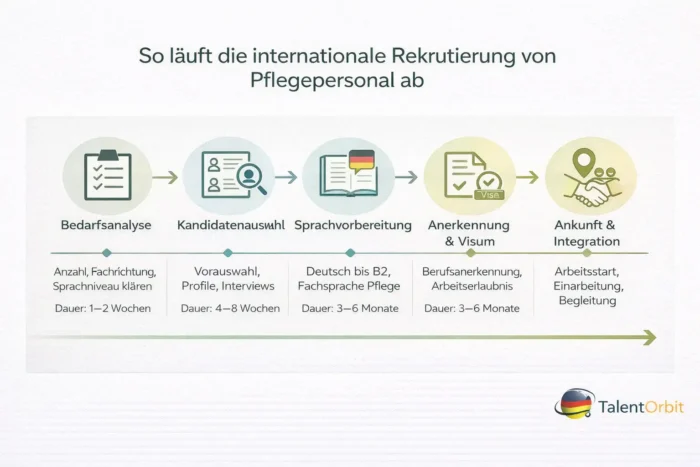
The process can be planned, but it has steps that take time. Here is the realistic process:
The complete process with all legal framework: have been summarized on a separate page. You can find a detailed cost and timeline analysis in our Practical guide to recruiting international nursing staff.
Placement is only half the job. The real question for facilities is: will the specialist stay? The turnover rate for internationally recruited nursing staff depends directly on how the first few months are organized.
Structured induction. A fixed contact person in the team, a realistic induction plan and regular feedback meetings in the first three months. This sounds obvious, but in practice it is often sacrificed to day-to-day business.
Linguistic development. B2 is enough to get you started. For long-term work at eye level - team discussions, jokes during breaks, resolving conflicts - more is needed. Institutions that offer further language courses invest directly in retention.
Fair working conditions. Internationally recruited specialists talk to each other - via WhatsApp groups, in communities, with colleagues in other institutions. If the conditions aren't right, word gets around. And the next employer in Germany is just an application away.
Offer perspective. Further training opportunities, realistic career paths, support for family reunification. Skilled workers who see a future in your location stay. Skilled workers who feel they are being treated as wear and tear leave.
The market for international nursing staff recruitment has grown significantly in recent years - and not all providers work to the same standards. Here are a few points you should consider when making your choice:
Transparent cost structure. Reputable agencies state the total costs in advance. Beware of models that pass on costs to the specialists - in many cases this is not only ethically problematic, but also contradicts the WHO Global Code of Practice.
Own local partners. Agencies that maintain direct relationships with training institutions and authorities in the countries of origin are better able to ensure the quality of candidates than pure placement platforms.
Aftercare. Ask what happens after you start work. If the answer is „Nothing, that's up to you“, you are missing a crucial building block.
Ethical standards. Are professionals informed about their rights? Are they treated fairly? Is there a commitment clause that obliges them to pay back in the event of premature termination? Such practices exist - and they destroy not only trust, but also successful placements.
If you have vacancies that have been unfilled for months or if you know that there will be staff departures in the coming months - then it's worth talking to us. Together, we will clarify whether international recruitment is an option for your organization, how many positions can realistically be filled and what timeframe you should expect.
Arrange a non-binding initial consultation: Contact page
TalentOrbit International GmbH | Monheim am Rhein | +49(0)21732653870 | in**@*********it.de