

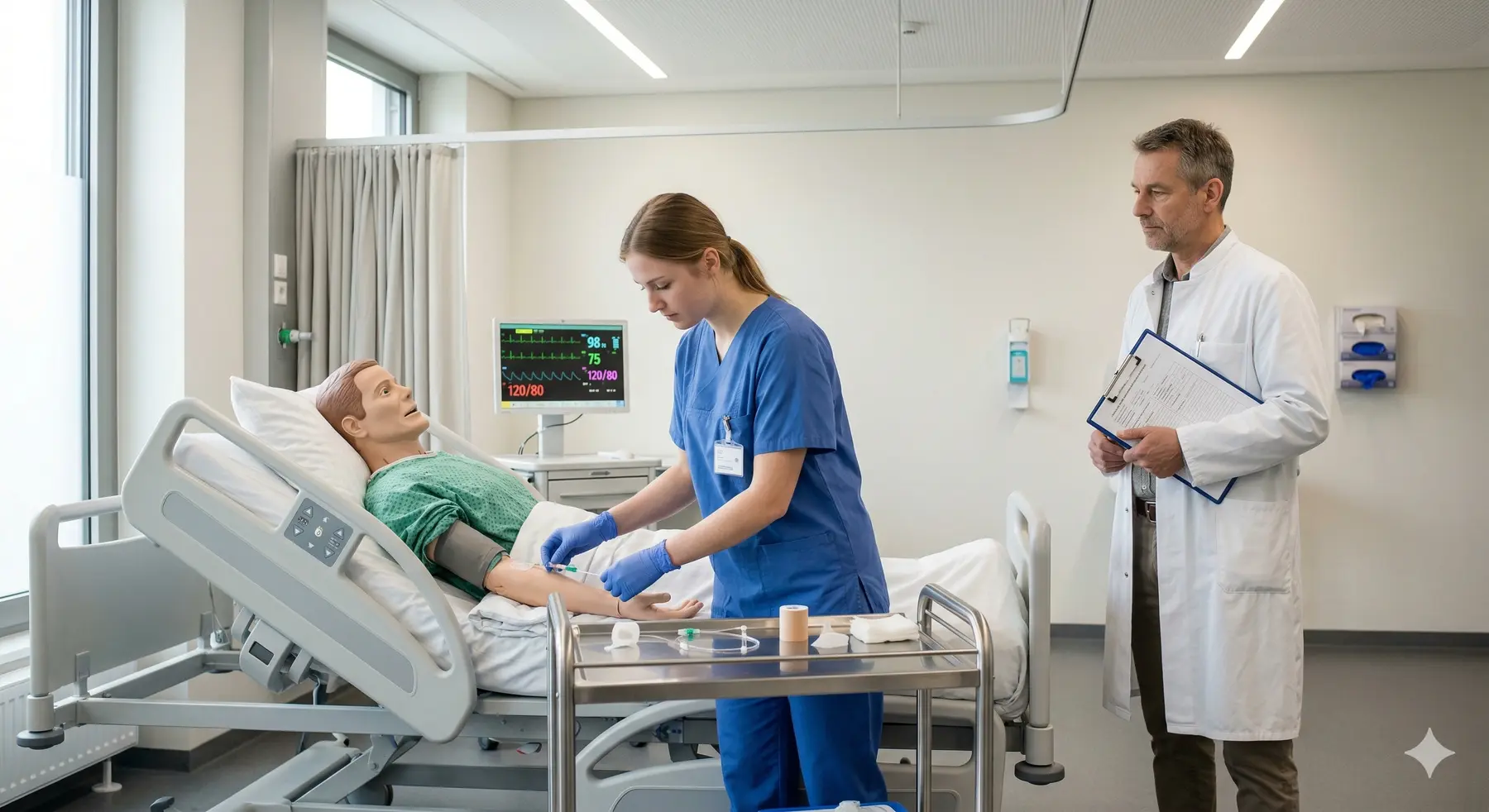
This article provides general information about the knowledge examination in nursing. The exact examination requirements vary by federal state and responsible authority. For your specific situation, please contact the responsible recognition office or a specialized advisor.
You have your deficit notice in your hand. The recognition authority has determined that your nursing education from abroad is not fully equivalent to the German one. Now you are faced with a decision: knowledge test or adaptation course?
Or you are an employer who has just hired three nurses from the Philippines, all of whom must pass the knowledge test – and you are wondering what exactly awaits your team, what it will cost, and how you can best support the process.
Both perspectives belong together. Because whether the knowledge test is successful depends not only on the caregiver, but also on how well the employer supports them on that path. This guide explains the process, compares the options, and identifies the pitfalls — with concrete figures and practical recommendations.
Last updated: March 2026. Takes into account the Ordinance on Training and Examinations for Care Professions (PflAPrV) in the version applicable from January 1, 2025.
The knowledge test is a so-called compensatory measure. It is proof that a nurse trained abroad possesses the skills required for professional practice as a registered nurse or licensed practical nurse in Germany. Section 45 of the Nursing Professions Training and Examination Ordinance (PflAPrV) forms the legal basis.
The examination becomes necessary if the competent recognition authority determines significant differences to the German nursing training during the equivalence assessment of the foreign qualification. These differences are documented in a so-called deficit notice—a document that precisely lists in which areas of competence the nurse needs to catch up.
Those who pass the knowledge examination will receive a professional certificate as a registered nurse. This certificate is identical to the one received by graduates of the regular German nursing training program. There is no difference legally or professionally.
Anyone who receives a notice of deficiency essentially has two options to compensate for the identified discrepancies. Both lead to the same goal – full professional recognition. However, they differ significantly in duration, cost, effort, and risk.
| Criterion | Knowledge test | Adaptation course |
| Duration | Preparation time approx. 3–6 months, exam itself 1–2 days | 6–18 months, depending on the extent of the deficits and the federal state |
| Format | One-time exam: oral + practical part | Supervised practical phase with theoretical modules and final discussion |
| Costs | 500–2,000 € (Exam fee + preparation course) | €3,000–€8,000 (course fees, potentially living expenses for longer durations) |
| Time until recognition | Faster — with passing on the first attempt, full recognition can be achieved within a few months | Slower — the course usually lasts at least six months |
| Risk | Higher: If you fail, the exam must be repeated (maximum one retake). Two failed attempts = remedial training will be necessary. | No risk of "dropping out" in the traditional sense — the course will be passed if the practical performance is satisfactory and the final interview is positive. |
| Work situation during the proceedings | Nursing assistant working as a nursing assistant (license according to § 24 PflBG) and preparing for the exam concurrently | Nursing staff completes the training course, often in combination with practical work in the facility. |
| Suitable for | Nurses with solid training, good German language skills (at least B2), and examination experience | Caregivers with greater training deficits, weaker language skills, or severe test anxiety |
The recommendation in practice: The knowledge test is the faster and cheaper way — if the prerequisites are met. The decisive criterion is not just technical knowledge, but the combination of professional competence and German technical language. Those who are well-trained professionally but still struggle with German nursing terminology often fare better with the adaptation course.
Some federal states now also require a final examination for the supplementary course. Please inquire with your responsible authority about the exact requirements in your federal state.
The knowledge test consists of two parts, both of which must be passed: an oral and a practical part. The specific test content is based on the individual deficit notice – not every nursing assistant will be tested in the same areas.
The oral examination lasts a maximum of 60 minutes. It begins with a case study that the nurse must analyze. Based on this, the examiners will ask specific questions about the areas of competence mentioned in the deficit notice.
The five competence areas of the generalist nursing education that can be examined:
The oral part is not about memorized definitions. Examiners expect nurses to be able to argue with professional reasoning and establish connections – in German, using nursing terminology.
The practical exam lasts a maximum of 120 minutes (excluding preparation time). The caregiver will provide care for at least two individuals requiring care in real care situations—in a hospital, a nursing home, or an outpatient service that also offers training positions.
The usual process:
If the safety of the care recipient is jeopardized during the practical examination, the examiners can terminate the examination. This usually leads to failure.
The knowledge test is conducted by a state-recognized nursing school. The choice of the facility where the practical part takes place is made in consultation with the nursing school — often it is the facility where the nurse already works as an assistant.
One has to be honest here: there are no reliable, nationwide statistics on the pass rate for the nursing knowledge test. The Federal Statistical Office does not record separate failure rates for the knowledge test for international nursing staff. Several federal states confirmed upon request (documented via FragDenStaat) that they do not keep systematic statistics.
What we know from available sources:
Realistic assessment Those who approach it with a solid B2 level, targeted exam preparation, and practical experience in a German institution have good chances. The exam is demanding, but achievable. Those who take it without preparation and with a B1 or weak B2 level are taking a high risk.
The knowledge test is not a test that can be passed alone. Employers who systematically support their international nurses have significantly higher success rates - and retain the specialists long-term. Those who leave the nurse's preparation to themselves risk months of delays and frustration on both sides.
Proven concrete measures:
For employers who wish to have the entire recruitment and recognition process professionally managed: TalentOrbit International GmbH coordinates the Recognition of foreign nursing qualifications from application to professional certificate — including exam preparation and language training. Talk to us.
Those who take the nursing knowledge exam seriously begin their preparation at least three months before the exam date. This doesn't mean three months of full-time preparation are necessary—but it does take time to systematically work through the exam content alongside your work as a nursing assistant.
There are now numerous providers that specifically prepare you for the nursing knowledge exam. The formats range from multi-week in-person courses to online intensive courses. When choosing, you should pay attention to three things: Is the course led by experienced nursing educators? Is nursing terminology trained in addition to subject knowledge? Are there exam simulations?
The costs generally range from 500 to 2,000 euros, depending on the scope and provider. Some federal states offer funding for exam preparation through the Employment Agency or the Job Center – inquire about funding options before the course begins.
The standard works for exam preparation are aligned with the curriculum for general nursing training. Particularly well-proven:
For a nurse working full-time as a nursing assistant and preparing for the knowledge test concurrently, a realistic schedule might look like this:
What happens if the knowledge test is failed? First, the most important news: it's not the end of the world. And it happens more often than most people admit.
The regulation is clear: Each part of the knowledge test (oral and practical) can be repeated once. Anyone who fails only a part must retake only that part — not the entire exam. The retake must generally take place within twelve months. The exact deadlines are set by the responsible authority.
Even if the re-examination is not passed, the path through the adjustment course is still open. This course is more time-consuming, but it has the advantage that the nursing staff is accompanied over a longer period and any gaps are systematically closed.
For employers, failure means: Your caregiver will continue to work as a nursing assistant — you won't lose them. However, full recognition, and therefore the ability to utilize and bill for the professional as a certified nurse, will be delayed by several months. Each month without recognition is a month in which the professional cannot reach their full potential and you, as the employer, cannot fill the position as a specialized role.
This is the strongest reason to invest in good preparation — not just when the exam is already looming.
The knowledge test is organized at the state level. This means that although the legal basis (PflAPrV) is valid nationwide, the implementation details differ from state to state. The main differences concern:
For international nurses coming to Germany through an employer: The choice of federal state—and thus the recognition authority—depends on the place of work. If you as an employer have locations in multiple federal states, it may be beneficial to strategically plan the recognition procedures. TalentOrbit knows the Differences between the federal states in the recognition procedure and advises you on it.
The oral part lasts a maximum of 60 minutes, and the practical part lasts a maximum of 120 minutes (excluding preparation time). The preparation phase for the practical part includes up to 240 minutes. Both parts typically take place on one to two days. The preparation time from registration to the exam is usually three to six months.
The examination fees vary by federal state and are typically between 300 and 800 euros. In addition, there are costs for preparation courses (500–2,000 euros) and, if necessary, specialized language training. The total costs thus range from approximately 1,000 to 3,000 euros. Many employers cover these costs as part of the Recruitment and integration process.
Yes. Anyone who receives a deficit notice has the right to choose between both compensatory measures. In practice, there are situations where the responsible authority makes a recommendation—especially if the deficits are extensive. However, the decision lies with the care provider.
Each part of the exam can be retaken once. Therefore, if you pass the oral part but not the practical part, you only have to retake the practical part. In total, you have a maximum of two attempts per exam part. If both attempts are failed, the supplementary training course must be completed.
Formally, at least German B2 is required — this is the overall prerequisite for professional recognition. In practice, examination experts and experienced preparation course instructors strongly recommend at least B2 with solid nursing terminology, ideally Telc Deutsch B2-C1 Pflege. Those who take the exam with B1 or a weak B2 often fail due to the specialized language, not the professional knowledge.
The legal basis (§ 45 PflAPrV) applies nationwide, but its implementation varies. The scope of the examination, fees, waiting times, and organizational details differ depending on the federal state and the responsible authority. There is no central, nationwide uniform examination.
The knowledge test is challenging but achievable – if you prepare properly. For international nurses, it's the quickest path to full professional recognition. For employers, it's a worthwhile investment: Every month saved in the recognition process is a month your skilled professional can contribute their full potential on the ward.
TalentOrbit International GmbH accompanies the entire process Placement of International Nurses about the recognition up to sustainable integration. If you have questions or need support with exam preparation for your international nurses: Get in touch with us for a no-obligation consultation.